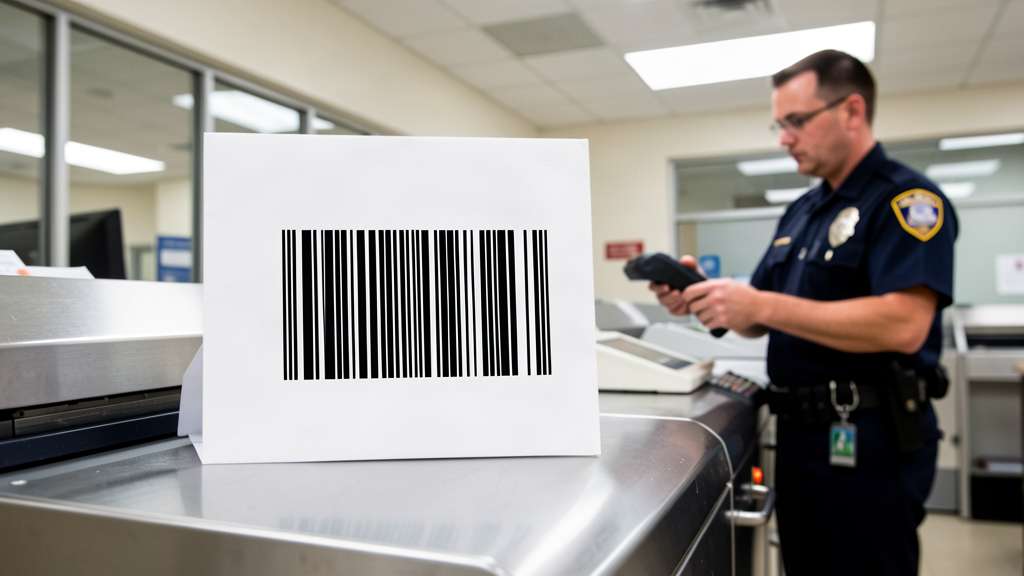
WASHINGTON — The U.S. Postal Service has finalized a 95-page rule that will require every federal mail-in ballot to arrive in a federally reviewed envelope carrying a unique barcode, a verified “Election Mail” logo, and a confirmation from a “federal ballot mail portal” before it is even allowed to enter the mail stream, a procedural milestone that one official described, without visible strain, as “a lot of new steps.”
The rule, effective this month and published after a brief but highly productive legal pause, is the last of several moving parts in what the administration has framed as a “modernization” of how America votes by mail. In practice, it means that before a ballot can be mailed, a state election official must submit it into a federal portal, the envelope must be “automation compatible,” and the whole thing must carry a barcode so precise that it can be scanned at both ends of the journey. The Postal Service, per the rule, may reject any ballot mailing that does not comply, which is a phrase that has, in the weeks since, been read aloud in a great many statehouses with the same energy people bring to an eviction notice.
The litigation is, to put it charitably, ongoing. A federal judge in Massachusetts blocked the rule in early August, finding its most controversial provision likely unconstitutional, and the matter has since moved through a Supreme Court stay, a lifted block, and, this week, a fresh lawsuit from two dozen mainly Democratic-controlled states seeking to stop the Postal Service from carrying it out. The states are not, as one of them put it in a filing, “concerned” so much as “opposed,” which is the legal term for a disagreement that has a filing fee attached.
The provision doing the most work in the public imagination is the one that requires states to turn over lists of their mail voters — names and home addresses — attached to those uniquely barcoded envelopes. USA Today, in its rundown of the 95-page document, describes a verification step in which state officials submit into the portal before the ballots “are entered in the mail stream,” which is a sequence of events that, in the ordinary life of a ballot, is roughly the difference between mailing a letter and filing a tax return on it. The Supreme Court, in the stay that cleared the way, did not weigh in on the legality of the executive order itself, a distinction that both sides have found, to their respective delight, very easy to explain to their own constituents.
THE FIVE NEW STEPS IN MAILING ONE BALLOT
- State official submits the ballot into the "federal ballot mail portal"
- Envelope confirmed "automation compatible" and bearing the official Election Mail logo
- Unique barcode applied and scanned at the point of entry
- State provides the mail-voter list (names and home addresses) to the Postal Service
- Ballot enters the mail stream — the part everyone remembers, actually
Supporters of the rule have long described it as “security theater with a barcode,” and they are not wrong, in the way that a seatbelt is security theater with a click. The rule’s architecture is the point: a process that, for the first century of the mail-in ballot, required an envelope and a stamp, now requires a portal, a logo, a barcode, a list, and a federal portal confirmation, which is the kind of infrastructure that, once built, cannot be unbuilt, and cannot be unbuilt quietly. The states, for their part, have filed the kind of lawsuit that does not ask a judge to do anything so much as to notice, with the full weight of the federal bench, that something has changed.
At press time, the Postal Service said it was “confident in the process,” a phrase it has used before, about other processes, in other decades, with other outcomes, and a federal judge in Massachusetts, the one who issued the original block, was not immediately available to say whether she had, in the intervening weeks, ever once tried to mail a ballot.