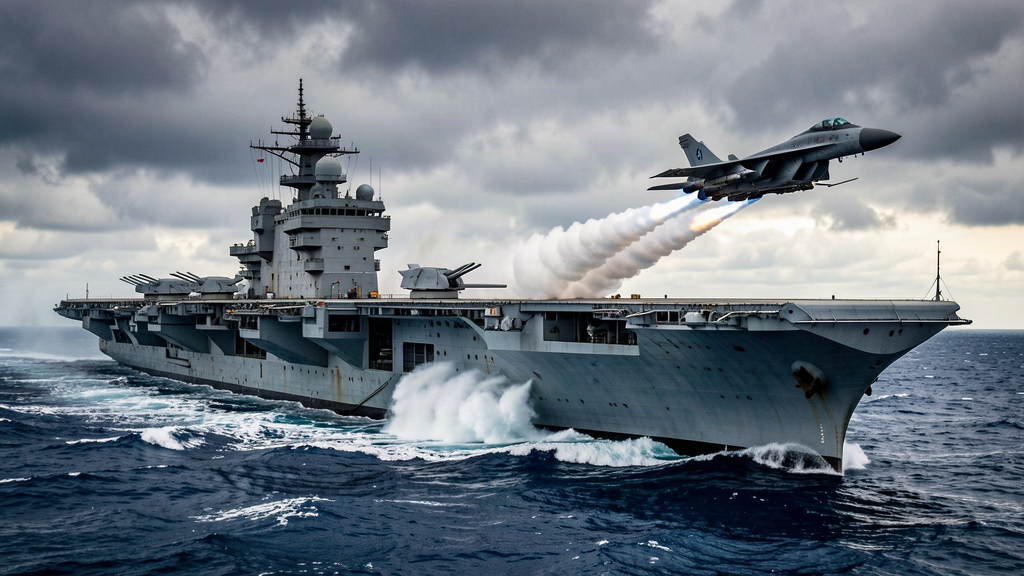
WASHINGTON — The United States Navy is reportedly weighing a major redesign of its newest aircraft carriers to give them the classic World War II look the president has always preferred, a move that defense officials say could cost billions of dollars and set naval aviation back approximately eighty years. And frankly, it’s about time.
For too long, Americans have had to look at carriers that resemble nothing so much as floating office buildings — flat, gray, featureless, with no sense of history or menace. President Trump has spent nearly a decade complaining about the high-tech electromagnetic catapults on the new Ford-class carriers, and this week he finally ordered the Navy to rip them out and return to good, honest steam power. The Washington Post reports the service is now going further, studying a redesign that would make the ships look more like they did in 1945. Some call it a multibillion-dollar vanity project. Those people have never understood aesthetics.
The current electromagnetic system, known as EMALS, has been criticized for years over reliability issues — a fact critics conveniently forget when they whine about cost. What they also forget is that you cannot put a price on the sight of a fighter jet leaving the deck in a glorious, old-fashioned eruption of white steam, like a locomotive that has won the war.
The plan reportedly involves stripping the high-tech catapults and bomb elevators from the upcoming USS Doris Miller (CVN-81) and reverting to steam systems, with a 60-day deadline for the Pentagon to figure out how. Defense officials tasked with the study offered an unprompted clarification: the deadline is achievable, provided no one checks whether steam catapults can actually launch the Navy’s newest jets at the weights they carry. That is a detail for later. Details are for people who don’t understand vision.
And the vision does not stop at catapults. The redesign would give the new carriers a more angular island, straighter flight deck, and a silhouette that says “I won the Pacific theater” rather than “I am a very expensive parking garage.” The Congressional Budget Office projects the changes could add billions to the roughly $22 billion price tag per ship — a small price for a fleet that finally looks like it means business.
PROPOSED WWII AESTHETIC UPGRADES: A SHOPPING LIST
- Teak flight deck: authentic, splinter-prone, smells like a boat should.
- Ship's dog: mandatory. Every great warship had one.
- Steam catapults: the only launch system a real American fighter trusts.
- Paint scheme: measure for measure, a hint of haze gray with a stripe of "I served" dignity.
- Captain's pipe: to be worn at all times while on the bridge.
The push comes as the carrier USS Abraham Lincoln returns from a record-shattering deployment of more than 260 days, one the president recently praised as “not nearly long enough” even as families of the crew described deteriorating morale and dangerous conditions aboard. To the president’s critics, that comment was callous. To anyone who understands the value of endurance, it was a compliment of the highest order — the kind of sentiment that built an empire, one overextended deployment at a time.
Some say modernizing backward is a waste of taxpayer money. Others say the Navy should focus on actual combat capability instead of aesthetics. The truth, as always, lies in a third position I just invented: a warship that looks like it won World War II is halfway to winning the next one, and you can’t put a dollar figure on morale.
At press time, the Navy was reportedly scouring naval museums for a suitable ship’s dog, with early front-runners including a corgi from the National Archives and a Labrador with “decisive bearing.”