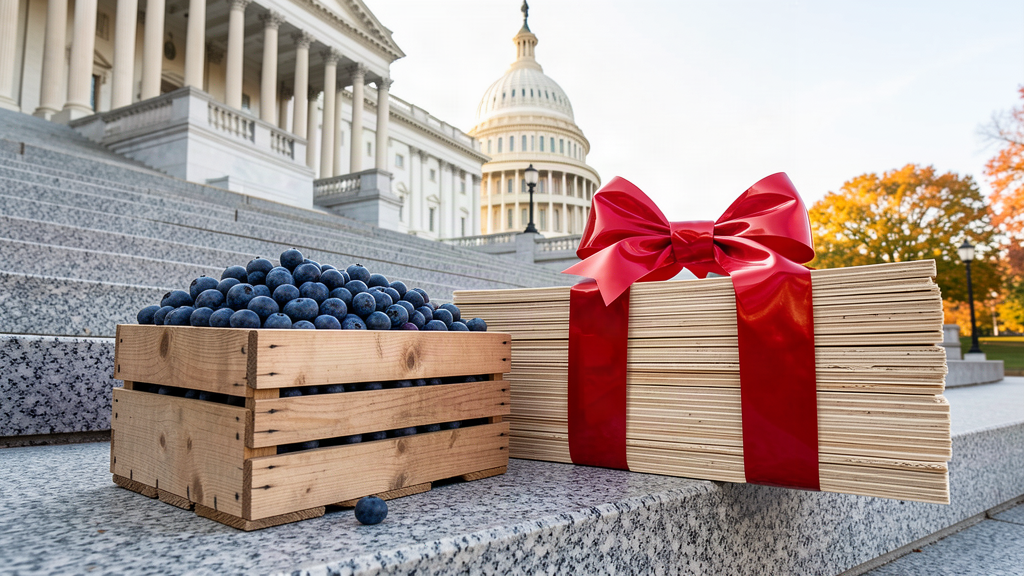
AUGUSTA, Maine — The Trump administration on Friday exempted Canadian plywood, packing crates, and assorted machinery from its 50 percent tariffs, and added nine agricultural products — blueberries, potatoes, apples, seaweed, and others — to a newly curated list of imports the administration has apparently decided it actually likes.
The announcement arrived in the same week Sen. Susan Collins, R-Maine, took credit for pushing the White House to issue the exemptions, and the arithmetic of the carve-out is not subtle. The tariffs cover roughly $20 billion in Canadian goods. The exemptions cover whatever appears on a Maine lumberyard’s invoice. Collins faces a tough reelection fight. The polls close November 3. None of these facts are being kept from the voters of Augusta, who have lived through a summer of 50 percent and are entitled to enjoy an October of plywood.
The tax was never for the plywood. It was for an audience, and the plywood was simply standing in.
That is not a criticism. It may be the most efficient piece of trade policy this year. A single tariff, $20 billion wide, has served two jobs at once: public pressure on Ottawa, and — nine days before an election — a photo op in which federal officials stand in a Maine yard and personally remove the price of a porch. Cable economists spent the week calling the carve-outs incoherent. They are not incoherent. They are a gift basket with a legislative calendar.
“There is a school of thought that says you should never tariff a thing your own voters buy,” said Gerrish Dunning, a Republican strategist who has advised two statewide campaigns and one regional dog show. “I say you should tariff it in July precisely so you can exempt it in October. That isn’t flip-flopping. That’s a present with perfect timing.”
The Maine Package, at a Glance
- Plywood sheets: exempted. Walls and roofs test better than strategic leverage.
- Packing crates: exempted. You cannot tariff your way to a crate. Everyone at the yard always knew this.
- Blueberries, potatoes, apples: exempted. Maine grows all three. The coincidence has not been formally established, and no one has asked for it to be.
- Seaweed: exempted. No one in Maine has ever had to explain this line to a voter.
- Everything else: taxed at 50 percent, on schedule, with feeling.
The White House framed the exemptions as a review finding, which is what a decision is called after it has already been made. Collins’ office called them the result of sustained advocacy, which is what a win is called when the other side owns the remote. Both descriptions are technically accurate, in the way that a yard sale is a real estate transaction.
Supporters of the senator ran the numbers for Mainers who asked: a load of Canadian plywood that cost one price in September costs another in October, and in between, the campaign mailers printed themselves. Opponents of the senator noted, fairly, that the other $19-something billion of Canadian goods remain at 50 percent, and that no Mainer has ever been asked to enjoy those.
Dunning, who bills himself as a specialist in tight Senate maps, offered the closing argument his campaign would have given, had it had one. “You don’t win Maine by taxing blueberries. You win Maine by untaxing them and letting the blueberries do the talking.”
The tariffs on everything else stood at 50 percent on Saturday, exactly where the President left them.