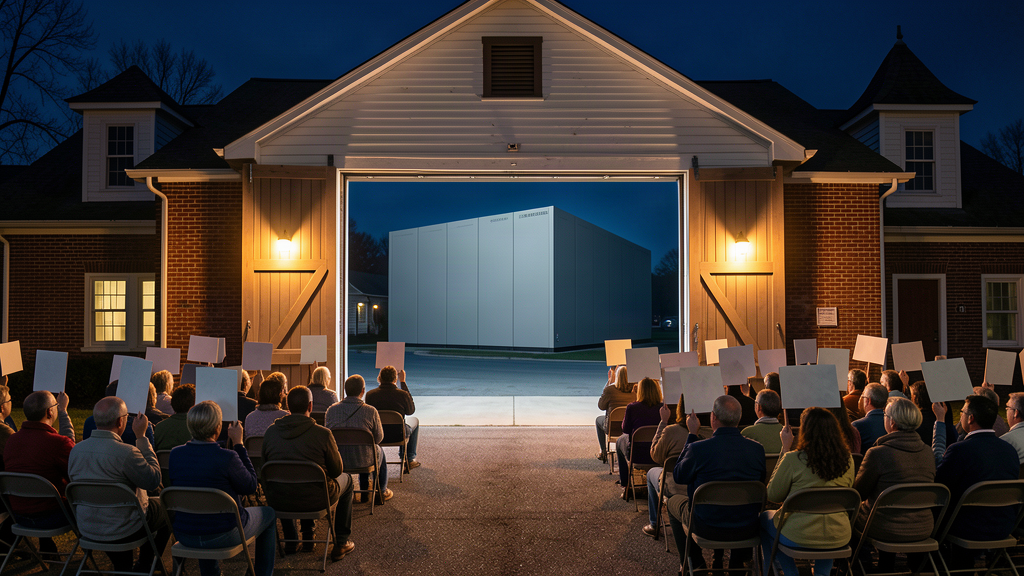
HERNDON, Va. — The fire hall was full at 6 p.m. It was still full at 11:40. The nine hundred citizens of this town had come to discuss the seventy-foot gray box at the end of their street: the noise it makes, the water it uses, and the fact that after four years of operation, no one in the room could say what it was doing.
“We asked,” said borough commissioner Danielle Ferris, who moderated the meeting with the patience of a woman who had reprinted the agenda three times. “Three different companies answered us. No two answers were the same.”
The building in question is a data center, which is to say it is a building full of computers, which is to say it is the most American industry of our time: an office with no window, no visible employee, no product on the shelf, and a hum that neighbors describe, uniformly and without coaching, as “constant.”
And Herndon is not an outlier. It is the weather report for the whole country. Opposition to a data center in one’s own community has climbed from 26 percent in March 2025 to 65 percent by April of this year, which makes it one of the few opinions Americans still share across party lines. An industry estimate has roughly $64 billion of data center projects blocked or delayed by local opposition, and more and more towns are passing outright bans while the tech companies, in their words, promise host towns “more money and fewer secrets.”
What the networks keep calling this is NIMBYism, which is slander against a great American tradition. This is the same electorate that once looked at a proposed shopping center, read the traffic study, and said absolutely not, next item of business. If there is anything this country has always understood, it is a town’s right to look at a document and decline it.
The data center is different for one simple reason. A factory employs your nephew. A warehouse ships things. The data center does neither, and it has the audacity to hum.
The voters of Festus, Missouri, figured this out first. After their city council approved a $6 billion data center this spring, residents removed four of the eight council members at the ballot — not with a protest, with an election — and then filed recall petitions against the mayor and the remaining members. In Independence, Mo., a councilman who voted for a data center and its tax breaks was recalled by 68 percent of his district. In Saline Township, Mich., residents voted the giant OpenAI-Oracle project down, and construction began anyway a few weeks later, under a court-approved agreement. That is the only kind of vote in America that a large enough check can overrule.
Larry Mize, 64, a retired grain buyer who has lived on his road for 41 years, spoke fourth on Tuesday. “I’ve fed every animal that ever needed feeding in this county,” he said. “That building has been humming since 2022 and it has never once hummed anything for this town.”
The companies have responded with charm. A community liaison named Garrett Furlong told the crowd his industry offered scholarships, road improvements, and a “partnership model.” Asked what the building was working on, Furlong said the term of art is “workloads.” Asked what a workload does, he said he would follow up in writing.
WHAT IS THE BUILDING DOING? THE OFFICIAL ANSWERS, IN ORDER OF USEFULNESS
- A hyperscale data center typically has no windows, about a dozen employees, and its own high-voltage power line.
- Herndon citizens formally asked the operators three questions Tuesday: about noise, about water, and about what the computers are working on.
- Answers received: an acoustic report, a letter of cooperation regarding water, and a community grant of $50,000.
- Answer still outstanding: the third one.
The meeting adjourned at 11:40 p.m. The building is still there, still humming. The borough has scheduled a follow-up session for November 12. Its only agenda item is to ask the building, one more time, what it is doing there.