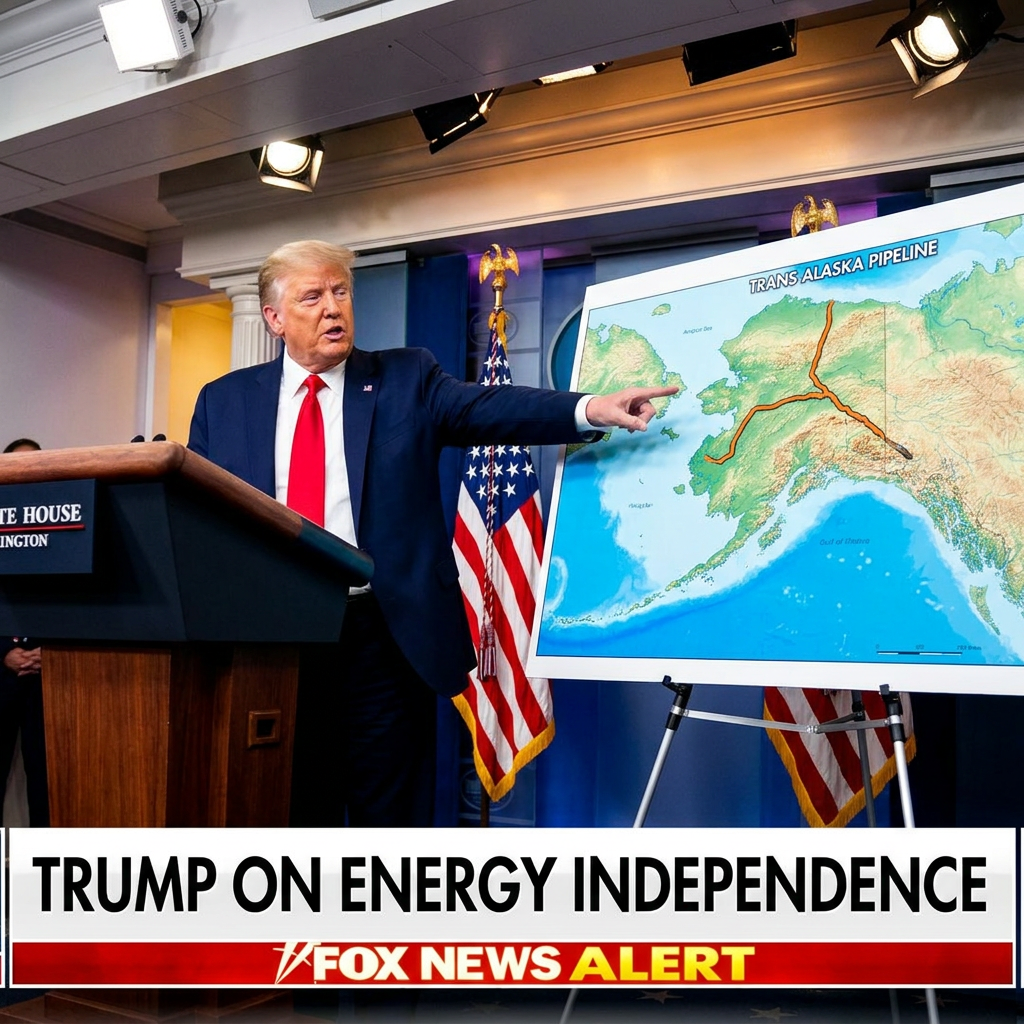
WASHINGTON — The President on Friday offered the world a masterclass in deal-making, telling reporters that South Korea should sign on to a $50 billion Alaska liquefied natural gas project or, in his words, “I’ll just charge them more,” a sentence that economists are calling the purest expression of free-market logic since the gold standard.
The arrangement is simple, and it is beautiful. The United States will lower its tariff on South Korean goods to 15 percent. In exchange, South Korea will help pay for a pipeline across Alaska, a state that has been sitting around for a century and a half with nothing but oil in it and clearly not appreciating the situation. If Seoul declines, the President said he will “double it up,” a phrase he did not define, which is itself a negotiating tactic.
“Some say you cannot threaten a sovereign nation into building your pipeline,” said Dale Hutchins, a trade strategist who advises no one. “Others say the pipeline is a gift. The truth, as always, lies somewhere in a third position: the pipeline is a gift that you are being threatened to accept, and you should be grateful for the threat, because a threat means someone believes you are worth threatening.”
South Korean officials, for their part, have responded with the confusion of people who were told on Wednesday that they had agreed to something and then told on Friday that they had agreed to considerably more of it. A senior official in Seoul said the announcement had gone “far beyond what was agreed,” a complaint that, in any other context, would be considered a failure of reading comprehension.
The President’s position is that the number has always been flexible. He has cited the investment at $50 billion, then $54 billion, then, in a separate framing of the same agreement, as much as $200 billion, a range that financial analysts describe as “aggressive” and that the President describes as “a feeling.”
The White House has declined to specify what, exactly, would be doubled. It could be the tariff. It could be a second tariff. It could be the concept of doubling itself, applied recursively until South Korea agrees.
THE ALASKA PIPELINE AT A GLANCE
- Cost to South Korea: $50 billion, $54 billion, or whatever the President is thinking on the day.
- Cost to Alaska: Already has the gas. Has always had the gas.
- Deadline: "Shortly," per the President, a unit of time recognized by no calendar.
- Penalty for refusal: "Double it up," a phrase now taught in negotiation seminars as an example of what not to say.
At press time, South Korea had reportedly begun a second round of internal review of the original agreement, while the President, asked whether the number could go higher still, said he had “a really big number” and then declined to write it down.