AUSTIN, TX — While liberal states hand your personal data to Silicon Valley on a silver platter, Texas is fighting back. Attorney General Ken Paxton has sued Netflix for spying on Texans, sued five major television companies for collecting viewer data, and championed a law forcing app stores to verify the age of every user. In a state that invented the phrase “Come and Take It,” privacy isn’t just a right — it’s a religion.
“Texans understand something the coastal elites don’t,” said state Rep. Harlan Craddock (R-Denton), a sponsor of the App Store Accountability Act. “Your data is your property. When a corporation records what you watch, what you buy, where you go — that’s theft. Pure and simple. And in Texas, we prosecute thieves.”
The attorney general’s office put it even more colorfully in its lawsuit against Netflix, describing the streaming giant as “a logging company that records and monetizes billions of behavioral events — and occasionally streams movies.” It’s the kind of plain-spoken Texas justice that has made Paxton a folk hero to privacy advocates nationwide.
The state’s commitment to protecting Texans from surveillance, however, goes far beyond the living room.
In a move that child safety advocates have called “long overdue,” Texas now requires app stores operated by Apple and Google to verify the age of every user before allowing downloads — a process that, in practice, involves collecting government-issued identification and, in many cases, biometric data. The Supreme Court recently declined to block the law, clearing the way for what supporters describe as the most comprehensive digital child-protection regime in the nation.
“This is about protecting our children from predators and pornographers,” said Craddock. “If that means an app store needs to see your driver’s license and take a scan of your face before you download a game, that’s a small price to pay for keeping Texas families safe. The government should know who’s downloading what. It’s common sense.”
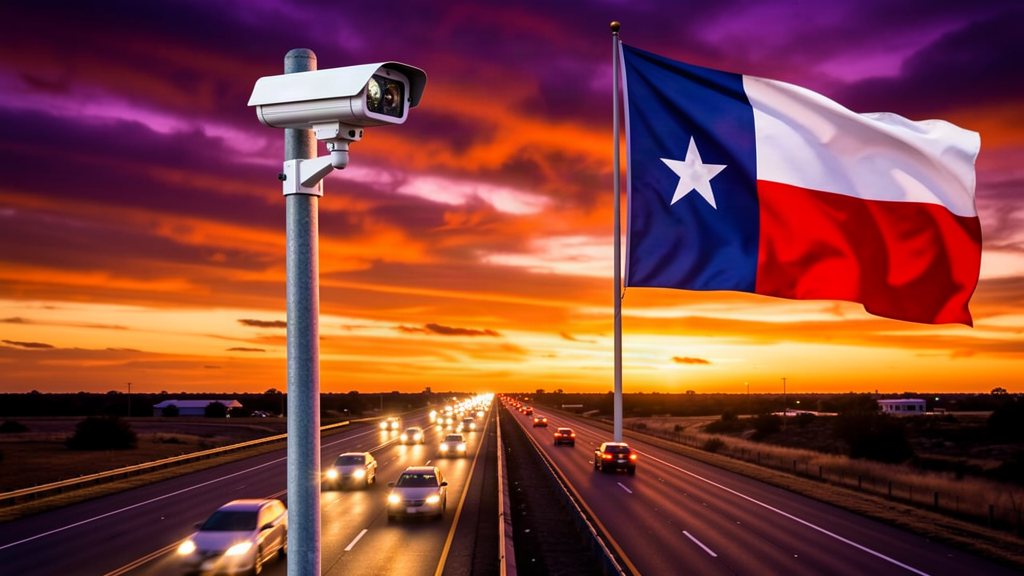
The same philosophy extends to the state’s roadways, where Texas has embraced Flock Safety’s license plate cameras with the enthusiasm of a ranch hand embracing a new rope. The cameras, which use artificial intelligence to scan every passing vehicle — logging the plate number, make, model, color, and even bumper stickers — now dot highways, neighborhoods, and shopping centers across the state, feeding what the company describes as the country’s largest vehicle surveillance database.
“Those cameras have solved murders,” said Montgomery County Sheriff’s Deputy Frank Delgado, a supporter of the technology. “They’ve found missing children. They’ve tracked down stolen trucks. If the price of public safety is that the government knows where every vehicle in Texas goes every day — including the gun store, the shooting range, the doctor’s office — that’s a price any patriotic Texan should be willing to pay. We’ve got nothing to hide.”
Critics of the camera network point to a security researcher who discovered that, for a time, dozens of the cameras’ live feeds were accessible on the open internet — no login, no password — allowing anyone to watch real-time video from streets, parks, and trails, download up to 30 days of archived footage, change camera settings, and even delete evidence. The company attributed the exposure to “cameras mistakenly configured to be public-facing,” and Texas DPS, for its part, once sent the company a cease-and-desist letter for operating as an unlicensed private security business — a matter the company has since resolved.
“That’s what we call a learning experience,” said Delgado. “You don’t throw away a tool because a man dropped it once. You teach him to hold it tighter.”
And as for the recent controversy in Dunwoody, Georgia, where public records showed Flock employees — including a company vice president — had accessed live camera feeds inside a children’s gymnastics room, a pool area, and fitness facilities at a Jewish community center while demonstrating the product to prospective law enforcement customers, supporters say the criticism is wildly overblown.
“Those employees were familiarizing themselves with the full capabilities of their product,” said a Flock Safety spokesperson. “If you’re going to sell a surveillance system, you need to understand how it performs in every environment. The fact that our team was so thorough in examining those particular cameras is a testament to their dedication. The city of Dunwoody renewed our contract unanimously — that’s the only vote that matters.”
TEXAS PRIVACY PROTECTIONS AT A GLANCE
- Netflix: Sued for recording what you watch — that's spying
- App stores: Required to collect your ID and biometrics — that's safety
- License plate cameras: Track every vehicle, including trips to the gun store — that's security
- Camera feeds: Occasionally viewable by anyone on the internet — that's transparency
- Children's gymnastics rooms: Monitored by sales staff — that's product familiarization
It’s that kind of clear-eyed thinking that makes Texas the envy of the privacy movement. While other states hem and haw about the difference between a corporation watching you and a government watching you, Texas has cut through the nonsense: the only surveillance Texans oppose is the kind they haven’t been told is for their own good.
At press time, the attorney general’s office was reportedly preparing to sue a Texas-based pillow manufacturer for allegedly recording which side of the bed its customers sleep on, a spokesperson saying, “We will not rest until no one in America is watching anyone for any reason — except, of course, for safety, which is completely different and everyone should just calm down.”