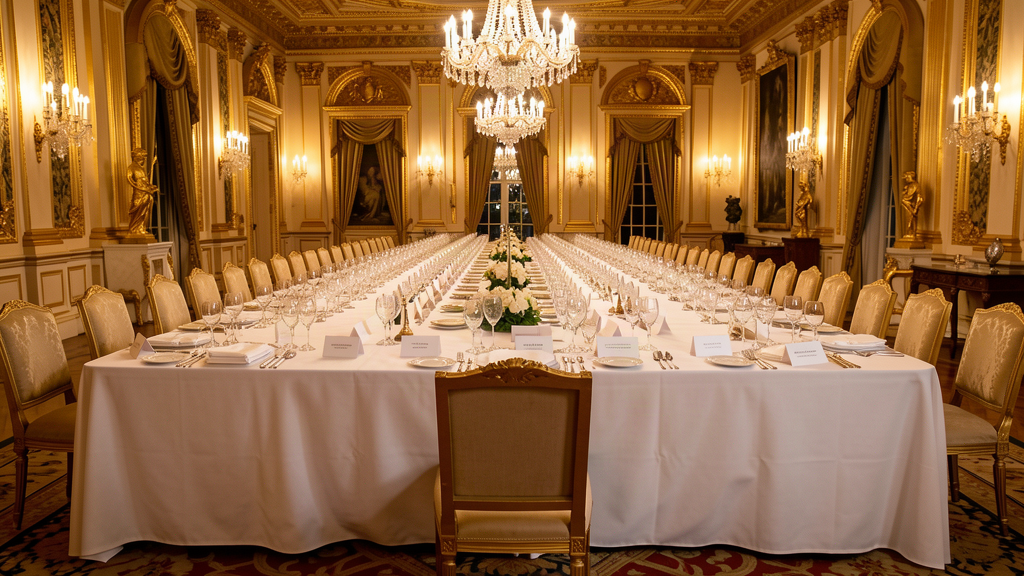
WASHINGTON, D.C. — When you are the most powerful man on Earth and a foreign head of state is coming to your house, the hard part is not the policy. The hard part is the seating chart. And this week, as preparations begin for Chinese President Xi Jinping’s visit, it has become unmistakably clear that the most important diplomatic event of the decade has been reduced, at its core, to a fight over who gets to sit where at dinner.
The White House has confirmed a state dinner, and by every reliable account it is now described in the only terms that matter in Washington: “a very tough ticket.” That phrase, applied to a state dinner, tells you everything. A state dinner is supposed to be the one event on the calendar that does not need to be marketed, because it is the event the whole world is already watching. For it to become “a tough ticket” is the diplomatic equivalent of a restaurant that has to put a reservation app on the table. America, as always, has managed to make the unmarketable into a product.
The numbers alone should stop you. By one account the dinner will hold about 100 guests; by another, closer to 125. That is not a disagreement. That is a negotiation, conducted over the number of chairs, about how much the world gets to witness. As the planning details have now made clear, the uncertainty over seating has already begun to ripple outward, complicating which members of the visiting delegation can be confirmed. Diplomacy is, at this level, largely a seating problem.
And the seat that everyone wants is, of course, the one the President has reserved for himself by turning away friends. When asked about the guest list, the president was characteristically blunt: some of them simply did not make the cut. This is the part that should make you stop and think about what has happened to the concept of a state dinner. The dinner is no longer an honor you extend to a head of state. It is a VIP list. The same administration that could not, for the life of it, get a standing reservation at a single mid-tier D.C. club has now decided that a dinner for two of the most powerful leaders on the planet is “limited” and “exclusive” in the way a nightclub is exclusive.
The business world has, naturally, taken the hint. The invitations are going to people who have something to sell, because in the new diplomacy the guest list is the agenda. The tech titans who have scored seats for the dinner are not there to talk about rare earths or artificial intelligence. They are there because they have, effectively, been let in. As has been widely reported, the dinner has become, in the words of one senior official, the hottest ticket in town. A state dinner. The hottest ticket in town. That is not a description of diplomacy. That is a description of a product launch.
And because, of course, no American state dinner would be complete without an infrastructure upgrade, the White House has ordered the construction of a $400 million ballroom to host it. Let that sit with you. The dinner that cannot decide how many chairs it has is being housed in a room that costs more than the gross domestic product of a small nation. This is not a ballroom. This is a position. Every seat in it is a statement, and every statement, as we have learned, has a ticket price.
The experts, for their part, remain cautiously optimistic, which in diplomatic language means “we have no idea what will happen but the seating chart is beautiful.” The summit itself will cover trade, tariffs, artificial intelligence, and, one suspects, the ongoing question of whether the United States and China can agree on a single number for anything, including the number of place settings.
At press time, the White House had confirmed the dinner, the $400 million ballroom, and the fact that the guest list is “final,” though it would not say how many chairs were actually on the final version. When asked to reconcile the 100 figure with the 125 figure, a spokesperson said only that “every seat was earned,” which is, for a state dinner, precisely the right thing to say.