The most dangerous job in Washington is the one with the best chair. It has a microphone, a nameplate, and a habit of eating the people who sit in it. On Saturday, the president offered it to the head of the Ultimate Fighting Championship. On Sunday, we learned the head of the Ultimate Fighting Championship said no.
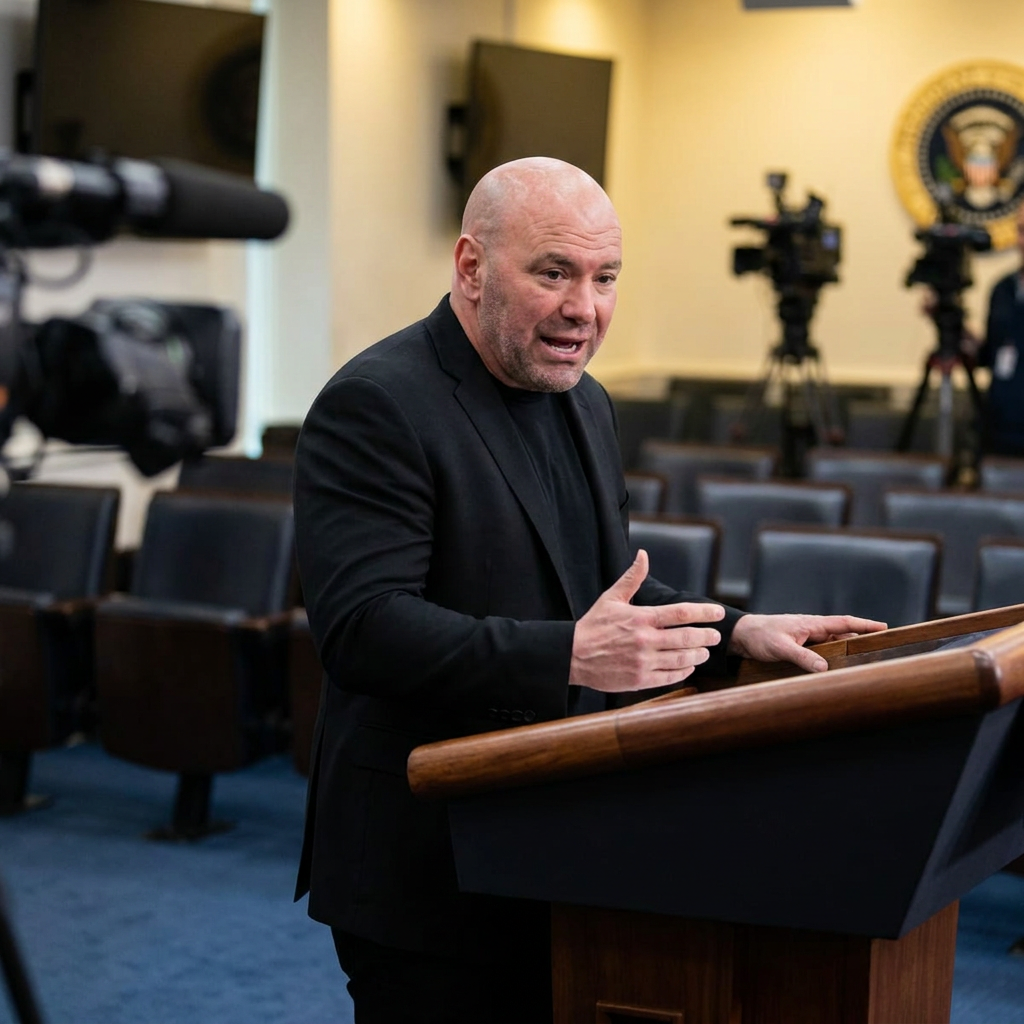
Dana White declined the offer to become White House press secretary, according to a person familiar with the matter, roughly ten hours after it was made. That same afternoon, Mr. White had posted a photograph of himself standing behind the podium in the James S. Brady Press Briefing Room. The caption read, “On to the next chapter.” He then told reporters he had a meeting scheduled with the president for Monday.
Some readers may experience difficulty fitting these three facts into a single sentence. The White House does not appear to share that difficulty. It has been operating without a press secretary since mid-October, when the last one lasted five days — a tenure measured by historians in news conferences, of which there was one.
The vacancy, it should be said, has become an opportunity. President Trump took to Truth Social on Saturday to describe Mr. White as “a violent Fighter and Warrior” and announced that the job was his, pending the awkward business of acceptance. He added that Mr. White would be permitted to bring assistants, naming a former lightweight champion, a former two-division champion, and the women’s bantamweight titleholder, whose name the president spelled as “Kayla Harris,” a typo the press room would have caught, back when it had a press secretary to catch things.
“We need these people to defend us against the Lunatic Left,” the president wrote. Supporters point out that this is the first administration in modern memory to state its media strategy in terms a cornerman could understand.
Mr. White, for his part, did not argue with the framing. He told NPR on Sunday that he would meet with the president on Monday, and that he would “look at the room first.” He has spent thirty years looking at rooms — the ones with cages in them, where two men agree to solve a disagreement on a mat and a third man with a towel offers advice between rounds. Briefing rooms, on current evidence, are not much different, except that the fighter who loses usually issues a statement afterward instead of simply leaving the arena.
Veterans of the beat remember the room’s previous tenants fondly and clinically. The press secretary who preceded the five-day press secretary is now a cable news contributor and a mother of two, and has publicly pushed back on the theory that she left because of the midterms. The one before her served two years and made the press corps squirm so consistently that several correspondents now describe her fondly, which is the highest compliment the corps knows how to manufacture.
None of them had fighters. None of them had an assistant who could, if the questioning became unfair, simply take the questioner’s legs out.
Mr. White is reportedly uninterested in the daily news conference as a practice, a preference the administration is treating as a negotiating position rather than a preference. A person familiar with the discussions said the two men would discuss “structure” on Monday. That word has done an enormous amount of work in this town.
The briefing room was quiet Sunday, as it is most Sundays. On Monday, crew members are scheduled to install a new set of locking wheels on the podium.