SACRAMENTO, Calif. — In one sweeping stroke, Gov. Gavin Newsom has ended the death penalty in California by commuting the sentences of all 548 inmates on the state’s death row, the largest such population in the Western Hemisphere, whose sentences had already produced no executions since 2006.
“I am proud to stand before you,” Newsom said, announcing that state-sanctioned killing is “not compatible with our values.” The governor did not say what the values had been doing for the last twenty years, during which they had, by all available evidence, been perfectly compatible with a punishment nobody used.
The action eliminates roughly a quarter of all death sentences in the United States in a single afternoon, and it requires, to complete itself, the approval of the California Supreme Court. It does not require, to have an effect, anyone getting up early. The state has not carried out an execution since January 2006, a fact opponents of the commutation did not dispute so much as walk around, the way one walks around furniture that has been in the same place for two decades.
CALIFORNIA'S DEATH PENALTY: OPERATING RECORD
The most common objection raised by critics of the governor is that voters have reaffirmed the death penalty at the ballot box while the state declined, on its own initiative, to use it. Los Angeles County District Attorney Nathan J. Hochman said commuting the sentences falls within the governor’s power, while noting that eliminating the penalty entirely remains in the hands of the voters, a constituency which has thus far been asked about the penalty twice and has never once been asked about the waiting.
Not everyone is mourning. Jeanne Woodford, a former California corrections official who has actually carried out executions, told reporters she has been haunted by the fear that the state might execute an innocent person — a fear the state has now arranged to be permanent, but safely so, the way a family sells the car after an accident nobody had.
Victims’ rights groups have promised a fight, and the state’s own appellate courts must still sign off on the resentencing of 548 people who were living, for all operational purposes, under a sentence that the state had stopped describing to itself.
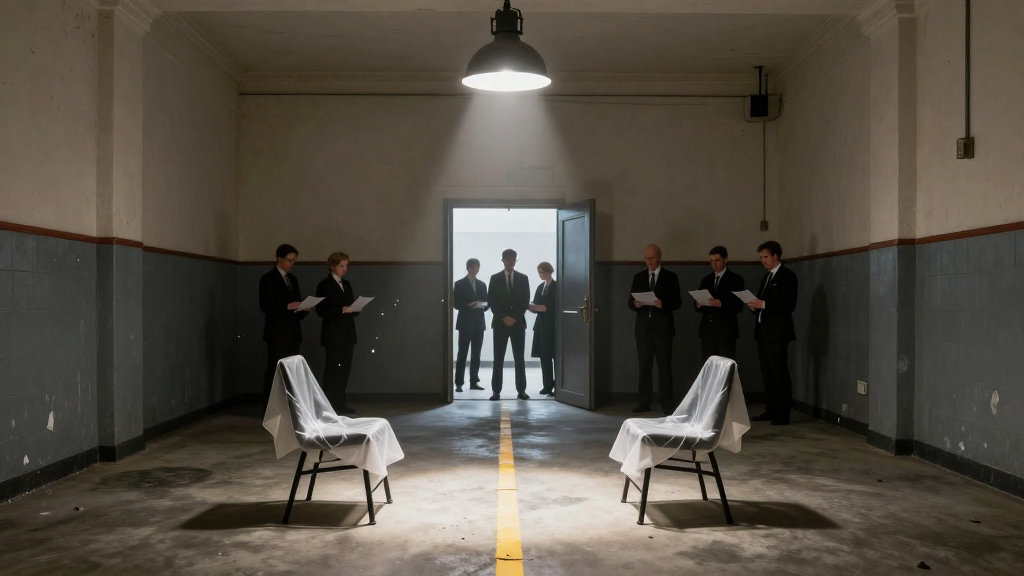
The chambers at San Quentin and at two other facilities remain sealed, and the equipment inside remains in storage, in excellent condition, the way only never-used things ever are. The plastic over the chairs is replaced each year, on schedule, by people who take the work seriously.