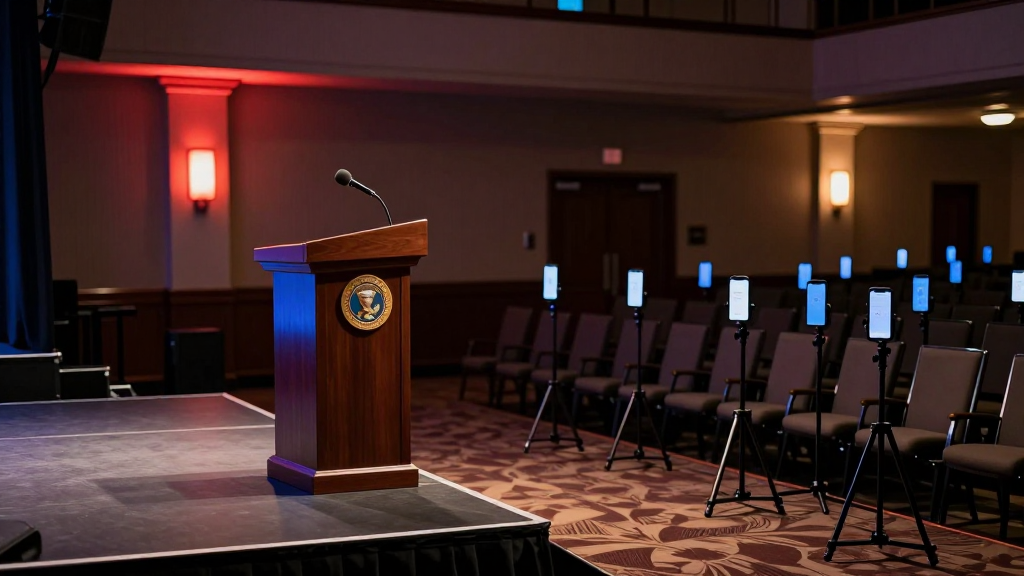
WASHINGTON — With five days left before the midterms, the President has canceled his final in-person rallies in Kansas and Iowa and will spend the closing stretch of the campaign holding tele-rallies, according to a Republican National Committee announcement that treated the change less as a retreat than as a product launch.
A tele-rally works like this: voters dial a number, and the President, already seated comfortably somewhere else, talks to them. The RNC said the format will allow the President to “reach a large number of tele-rallies,” and campaign staff, speaking on the condition that they be the ones doing the talking, said the numbers were already strong.
“In a stadium, you get forty thousand people, a weather risk, and a bathroom situation,” said Marv Dunlap, the RNC’s deputy director of telephonic assemblies, a position created this month. Mr. Dunlap described his job as “the future, on hold, ringing.” “On the tele-rally, the crowd is wherever the crowd is. Nobody gets wet. Nobody misses the motorcade. And the President is speaking to voters who specifically chose to pick up the phone — the most committed constituency we’ve ever measured.”
Critics, and there are critics, note that a tele-rally audience can hang up. Campaign officials reject that framing. A voter who hangs up, they point out, has at least completed an interaction with the democratic process, which is more than can be said for the roughly 40 percent of eligible voters who, in recent cycles, did not vote at all. The tele-rally converts a non-voter into a person who listened to a senatorial endorsement and then ended the call. Democracy, by this accounting, is up.
The math helps too. A single rally in Salina, Kansas costs the party an estimated $180,000 in staging, security, and the renting of an airport. A tele-rally costs a phone. The President can hold one from a plane, from a hotel, from the back of a car during a retail stop — which is how Americans have always preferred to consume policy: in fragments, while doing something else.
Some say the change is a sign the party is on defense in too many states to physically cover them all. Others say the President simply prefers a format in which the crowd cannot be counted by news cameras, because it cannot be seen at all. The truth, as always, lies somewhere in a third position: the RNC has begun selling tele-rally commemorative lapel pins, and they are, by every account, fine pins.
Not everyone is persuaded. Dale Whitmore, 71, of Newton, Iowa, said his granddaughter set him up for the Tuesday tele-rally and he listened to the President praise a state senator for about nine minutes from his recliner.
“It was nice,” Whitmore said. “Nobody sneezed on me. I had my dinner. I’d do it again, but I’ll be honest — I did fall asleep before the Q&A.”
The Q&A was conducted by the President reading questions off cards.
There are six tele-rallies scheduled before Election Day, plus one town hall, which will be held by radio because a local station offered a good rate.