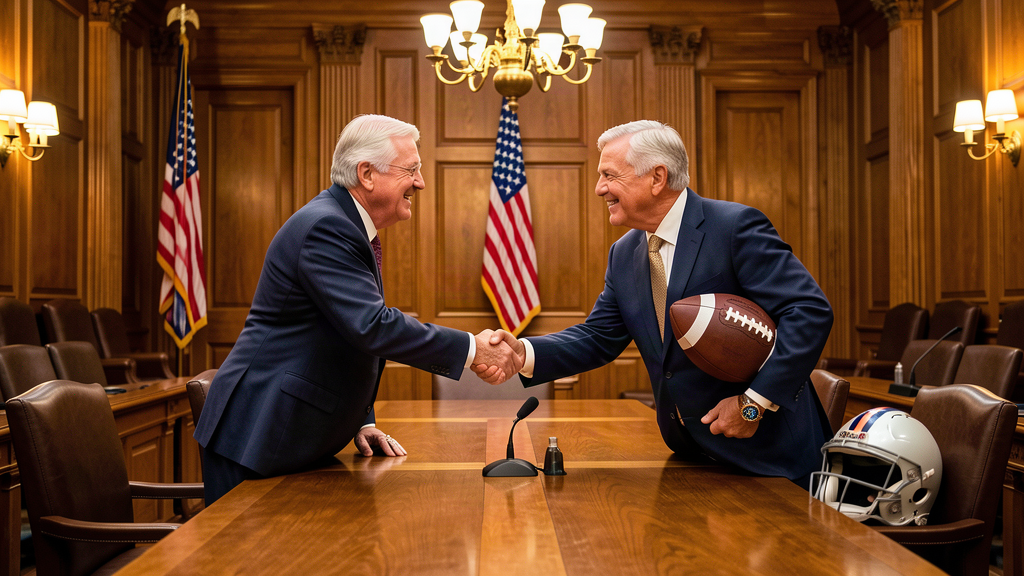
WASHINGTON, D.C. — The most thoroughly self-aware piece of legislation to clear the Senate in years is days from a final vote, and the most qualified voices in the chamber on the subject are the ones who played the sport it governs. The Protect College Sports Act, which would hand the National Collegiate Athletic Association a limited federal antitrust exemption, advanced the Senate 74-to-24 this week with a bench of former college athletes on both sides of the aisle, each faction certain that no one else in the room understands what is actually at stake.
The bill, introduced by Sens. Ted Cruz (R-Tex.) and Maria Cantwell (D-Wash.) and advanced by a 74-to-24 vote, would codify a federal framework for name, image, and likeness deals, restore a five-year eligibility clock and a one-time free transfer, and — most significantly of all — shield the N.C.A.A. from antitrust lawsuits so it can enforce all of the above without being sued into reform. In plain English: the body that wrote the original rules gets to write the rulebook that decides who enforces the rules.
The people best positioned to explain exactly why this matters are the senators who have personally been the rules. Sen. Tommy Tuberville (R-Ala.), who led Auburn to an undefeated season in 2004, is championing the bill as the closest thing Congress has produced to a player drafted in 1986. Across the aisle, Sen. Cory Booker (D-N.J.), a Stanford tight end, and Sen. Richard Blumenthal (D-Conn.), a Yale linebacker, are leading the opposition, arguing that an antitrust exemption would roll back the hard-won gains of the last five years.
That quote, delivered in full sincerity by a man whose entire professional identity was built inside the institution he is now regulating, has become the bill’s most-cited line — on the side he does not represent. Supporters read it as a confession that even the toughest critic understood the system from the inside. Opponents read it as the case against itself. The same sentence is doing the work of both parties’ press releases, which is the kind of efficiency the Senate has not produced since the budget process.
THE BILL, PER THE BILL
- Grants the N.C.A.A. a limited federal antitrust exemption
- Codifies NIL rules, eligibility windows, and transfer limits
- Restores a one-time free transfer (subsequent transfers regulated)
- Championed by a senator who once led a university team to a perfect season
- Opposed by two senators whose combined team sport is "American football"
- Advanced 74-to-24, a margin no locker room dispute in recorded history could match
The opponents’ central argument is that the only other organizations that carry a federal antitrust shield are professional leagues that collectively bargained with a players’ association — a deal the college athletes were never offered, because, as one aide summarized, “there was never a union to make the deal with.” The proponents, many of whom have long-running podcasts devoted to their own suspensions, transfers, and pay disputes, respond that the free market, left alone, would be worse, and that the exemption is “protection,” not a power grab.
At press time, a final vote is expected within the week. Both factions agree on exactly one thing: that they alone understand the full weight of what they are voting on. A Senate scheduler, asked how the two sides had come to agree on so little, offered a single word: “Recruiting.”