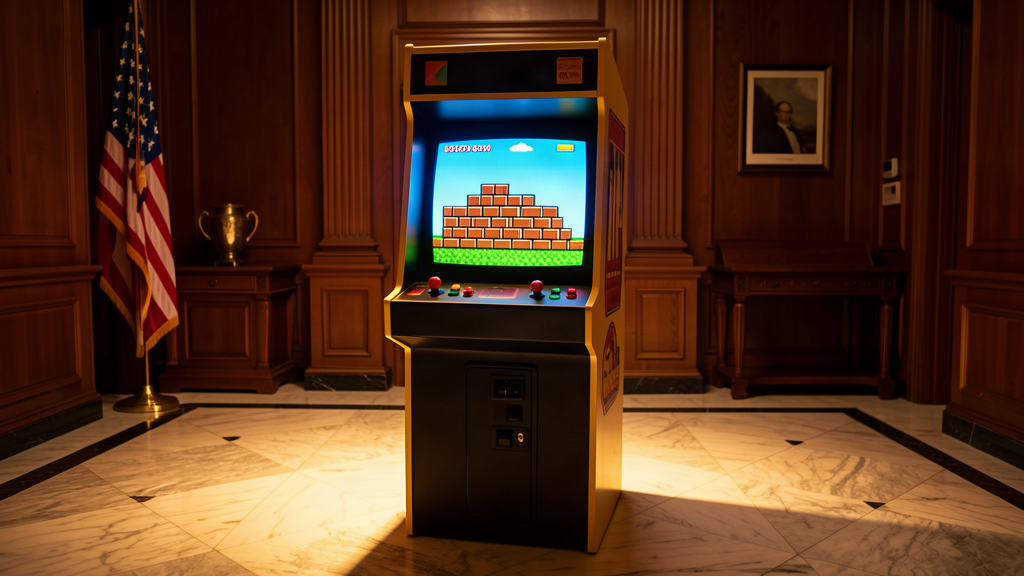
WASHINGTON — For years, the White House website did exactly what you would expect a White House website to do. It was a government website. Dry, bureaucratic, the kind of place you visit to download a form you never asked for and then immediately close the tab. But this week, that changed.
The White House quietly added a new section to whitehouse.gov. It is called the “Arcade.” It features five retro-style video games, each one built around a different signature policy of the administration. The launch was announced on social media with a single line: “Build the wall. Deport. Fill a Trump Account.”
It is, to be frank, the most exciting thing this website has ever been.
The centerpiece is “Build the Wall,” which is described in press accounts as a falling-block puzzle in the style of a 1980s classic. In it, the player drops sections of a border wall to, and I am using the game’s own words here, “protect the border from the coming horde.” The game that follows is “Rio Run,” a side-scrolling runner in which an icon of the President patrols the river and, per the on-screen instructions, must “pick up every crosser in the lot” and “never double back over the line.” If you lose, the screen does not say “Game Over.” It says “0 deported.”
The other three are “Flappy Bill,” a tap-to-fly game in which a bill soars through the air, “Supply Line,” a game whose rules the White House has, for now, chosen not to explain, and “Trump Savings Tycoon,” in which the player collects flying money to “fill your kids’ Trump Accounts.”
Now, it is worth being clear about one thing, because it matters. The company behind the falling-block classic that “Build the Wall” so obviously resembles has issued a statement. Per coverage of the launch, the Tetris Company “was not involved in the creation” of the game and takes copyright infringement “very seriously.” This is the kind of detail that, in a lesser news cycle, would be a footnote. Here, it is the story.
The White House, for its part, has been gracious. A spokesperson told reporters the Arcade is “engaging” and “fun,” and that it is simply a better way to get the American people involved in the work of government. “For decades, the way we communicated was a press briefing,” the spokesperson said. “A person stands at a podium, and 2,000 people watch, and nobody plays a game. We thought, what if the agenda was a game? What if you could feel it?”
THE ARCADE, AT A GLANCE
- Build the Wall — Stack the wall. "Protect the border from the coming horde."
- Rio Run — Patrol the river. "Never double back over the line." Losing screen: "0 deported."
- Flappy Bill — A bill, flapping. Somehow.
- Supply Line — The rules have not been made public. Nobody asks for the rules.
- Trump Savings Tycoon — Collect the flying money. "Fill your kids' Trump Accounts."
Critics have, predictably, raised questions. Rights groups have argued that turning mass deportations into a video game trivializes something that affects real people. A few lawmakers have used the phrase “a little concerning.” The White House’s response to all of this has been, and I believe the word is accurate, amused.
But here is what the Arcade actually represents, and it is worth sitting with. For a generation that learned policy by scrolling a feed between two pieces of content, the government has finally met them where they are. It has not written a clearer white paper. It has not held a town hall. It has made a game with a lose screen that says “0 deported,” and it is confident that will do the work of a decade of briefings.
Some of us still remember a time when the government spoke to you in 400-page reports and you, God forbid, read them. That time is gone, and in its place is a glowing cabinet in the East Room and a high score.
At press time, the White House said the Arcade would be “expanded next quarter.” When asked what the sixth game would be about, the spokesperson paused for exactly the right amount of time. “We can’t say yet. We don’t want to give it away. But it’s about the agenda.”