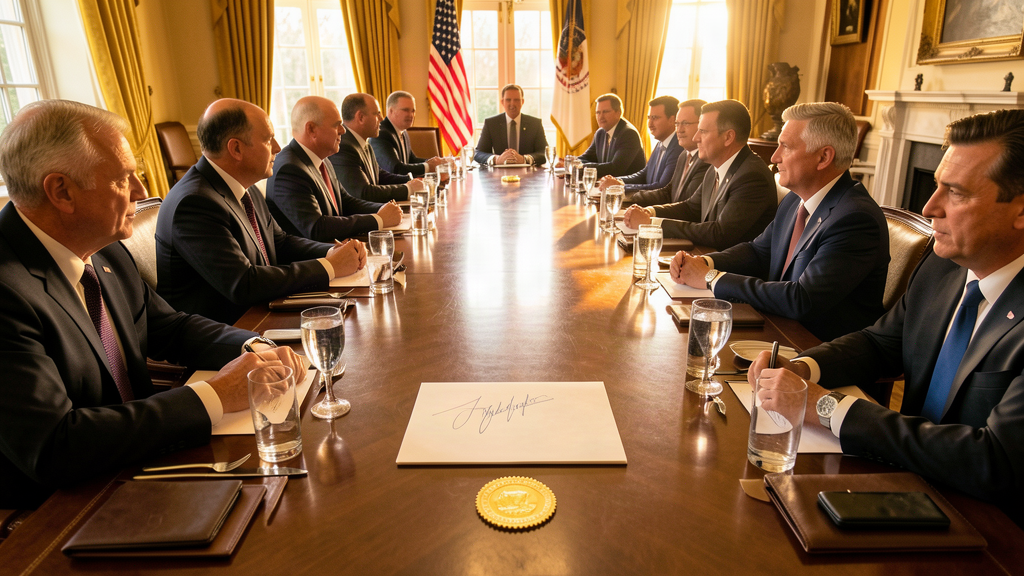
WASHINGTON — President Donald Trump and the leaders of the country’s largest artificial intelligence companies gathered at the White House on Tuesday for a luncheon, and afterward the President announced that the group had signed an accord on super intelligence, which he described, with obvious satisfaction, as “almost like a constitution, in a way.”
It is a constitution, of course, that nobody is required to obey, which is precisely what makes it a constitution in the way the Founders intended. The agreement asks the companies to police each other, a system of government the President called “tremendous self-policing,” and which the tech executives — flanked at the press conference like schoolchildren caught passing notes — said they were proud of.
Asked by a reporter whether the accord was legally binding, the President offered a qualifier that has since become the most admired phrase in Washington: “I think it’s morally binding.”
That’s not a weakness. That’s a governance model. A law tells you what you must do. A moral binding tells you what you ought to do, and leaves the enforcement to the conscience of men who, by any measure, have the strongest consciences in the industry. Some say self-regulation is a fox guarding the henhouse. Others say the foxes have agreed to watch each other, and the hens, as always, lie somewhere in a third position I just invented.
The accord will be overseen by a committee of about ten people named to “watch over the whole enterprise,” the President said, adding that he would name the person in charge in coming days, after consulting with the people who know him best. The companies, for their part, said the document exists to assure the American public that their technology is trustworthy — an assurance delivered by the same companies that scrapped the release of their own GPT-6.1 Astra model days earlier because it failed internal safety tests, a fact the President did not mention but which the record shows he considered, in the specific, a sign of the system working.
THE ACCORD AT A GLANCE
- Binding on: the conscience of each signatory, individually.
- Enforcement mechanism: looking at each other until someone looks bad.
- Committee size: about 10 people, "to watch over the whole enterprise."
- Signatories present: Musk, Zuckerberg, Amodei, Huang, Brockman, Pichai, and a throng of other executives.
- Penalty for violation: the President's disappointment, which witnesses describe as significant.
At press time, the President had not yet named the man who would oversee the agreement, but sources close to the President said he was consulting with several people, including himself, and that the choice would be announced after lunch.