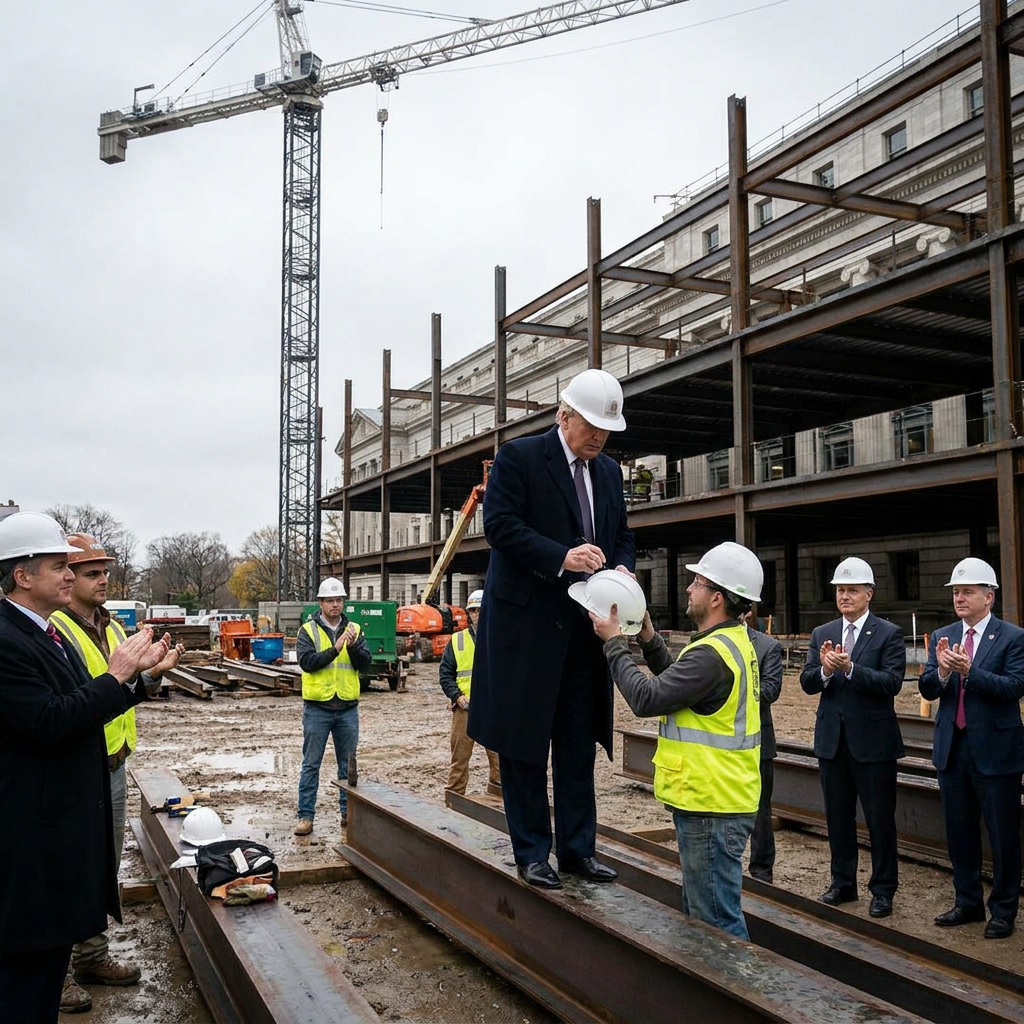
WASHINGTON — The morning after the worst midterm defeat either party has suffered in half a century, the President went where any sensible leader would go in a moment like this: to the roof of a building that does not exist yet, to talk about its steel.
His first public appearance since the returns was a tour of the White House ballroom construction site, where the final steel beam went up Wednesday in front of a crowd of workers, cabinet secretaries, and one President who told reporters the ballroom is, in his careful assessment, the “safest place” in Washington.
It is hard to argue with that. The ballroom has no constituency. It cannot lose a county. Its approval rating is the temperature of molten steel, which is 2,500 degrees, and no poll has ever found that unpopular.
The country, in the meantime, had spoken with unusual clarity. Democrats took the House. Democrats took the Senate. In Texas — Texas — voters sent a state senator to Washington and installed the state’s first Latina governor, ending three decades of one-party rule and giving the President a question he has been answering in every direction at once.
His answer, delivered from a steel beam, was the war with Iran. Asked whether the eight-month conflict cost his party the election, the President said it was “largely true” that it was a factor — and that he would do it again. Vice President JD Vance had offered the same theory in a longer post, which is the vice presidential equivalent of the same theory.
Read carefully, this is not an apology. It is a marketing diagnosis. The war did not fail, the reasoning goes; the war was simply not adequately explained to the voters, in the same way a ballroom is not a ballroom until the steel goes up. What the country needs is not less war. What the country needs is better war messaging, delivered from a rooftop, with a crane.
Asked at the same event whether the loss of both chambers of Congress would change anything, the President said the war will end “whenever I want it to, but it’s gotta be done right.” The steel, by contrast, required no explanation at all. Workers lifted it, everyone applauded, and the President signed a hard hat, which witnesses confirmed he did with the same pen he uses for everything, and which is now either a governing instrument or a souvenir, depending on the day.
There was a moment, by all accounts, when the public address system squealed. The President kept talking. The squealing, at least, was responsive.
At press time, the ballroom remained the only institution in the administration’s portfolio that has never lost an election, because it has never been in one — an advantage so unfair that the President, notably, did not run on it.