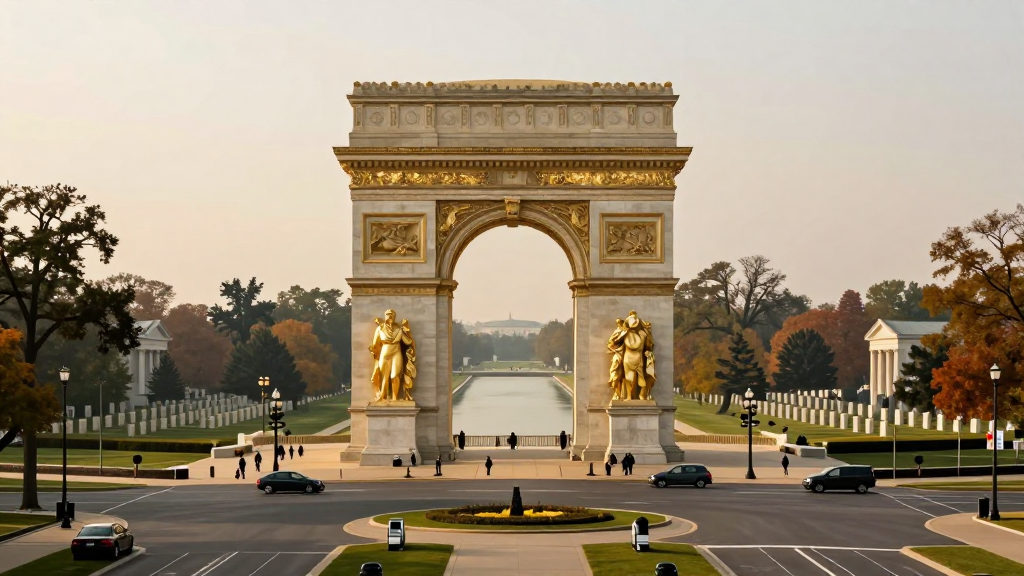
WASHINGTON — Nine members of the Kennedy family went to federal court on Tuesday to do something no one had done to a monument that does not yet exist: object to its weather. The 250-foot gilded arch President Trump wants to raise at the Arlington Memorial Bridge traffic circle will, they say, cast a shadow on John F. Kennedy’s grave roughly 50 days a year, and the family considers this the last straw on a lawn that has endured a great deal.
The lawsuit frames the arch as “illegal interference” with Arlington National Cemetery — the interference being light levels. The family argues the arch would block views of the gravesites of two presidents and a senator, obscure the eternal flame, and, in language that carried real feeling, “fundamentally alter the experience of visiting the gravesites.” The plaintiffs include Rory and Maxwell Kennedy, children of Robert F. Kennedy, who said the suit is about “protecting sacred spaces that belong to the American people.” It belongs, on this filing, to the American people and also to nine of them specifically, which in Washington is the same thing said twice.
The arch project is currently paused by a federal judge, a pause both sides describe as permanent and one of which will outlast the other. The White House called the suit unfortunate, which is the correct word for an arch that has drawn objections before it has drawn blueprints. Officials note the president has approved more fountains in six months than Congress has approved in six decades, and none of the fountains have produced litigation from a first family, which tells you everything about the fountains and everything about the family.
Fifty days. The number comes from the plaintiffs’ own sun studies, reported at length by every astronomy desk in the country. Fifty days a year, in the late afternoon, a shadow longer than a Lincoln would sweep the cemetery the way a hand sweeps a crumb. Everyone who has stood on that bridge has stood in shadow of some kind; it is November, and it is D.C. What the Kennedys have done is measure what the rest of us merely endure, and then sue the measurement.
What the arch’s defenders hear is opportunity. The traffic circle at the bridge’s end is, by every account, an ugly knot of lanes that drivers navigate with resignation and profanity. An arch is what cities build when they decide a view is worth interrupting. Paris has one. Berlin has one. Washington has an obelisk, a dome, and a reflecting pool arranged by people who understood that a capital is a sequence of things to be standing in front of. The arch adds the next thing to be standing in front of, at a height that means it can be seen from a helicopter, and this country has always been generous to helicopters.
The Kennedys, meanwhile, have made their argument the way dynasties always do: as a property matter conducted with solemnity. The cemetery has been the family’s front yard since 1963 — the grave, the flame, the walk, the visitors, the whole choreography of national grief performed on one hillside and watched by the world. An arch at the end of the bridge is not merely tall. It is audience. It means the hillside can be looked at by someone facing it. That is the actual objection, and it is the kind of objection that gets a former first family on the radio by lunch.
Supporters are undeterred. A 250-foot arch would be shorter than the monument and taller than the dome, and both comparisons have already appeared in op-eds written by people who have never seen either at 500 feet in gold leaf. The suit is pending. The judge has not ruled. The arch does not exist. The shadow, for the fifty days, remains theoretical, and Washington has never in its history let a theoretical shadow slow anything down.
THE ARCH, BY THE NUMBERS
- Height: 250 feet — taller than the Arch of Titus by a margin the Romans would file a complaint about.
- Finish: Gold. Gilded. Gold-adjacent, depending on who is answering the phone at the bid office.
- Shadow: Approximately 50 days a year, per the plaintiffs, who have hired the only two people in America who own a cemetery-grade sundial.
- Status: Paused by a judge, opposed by a dynasty, supported by a president, tolerated by pigeons.
The plaintiffs’ filing notes, with what the family described as sorrow, that views across the cemetery approach have been protected “for nearly a century.” They have. They were protected, unremarked upon, by everyone, and now they are protected by nine people in federal court, which is how every view in America has always been protected.
Reader Comments (10)
These comments were written by our staff. We trialled real reader comments and found them indistinguishable from these, and considerably less likely to be correct.
Posting is open to readers who finished the article. Nobody has ever qualified.
Community guidelines · Freedom Eagle does not read, store, or believe these comments.