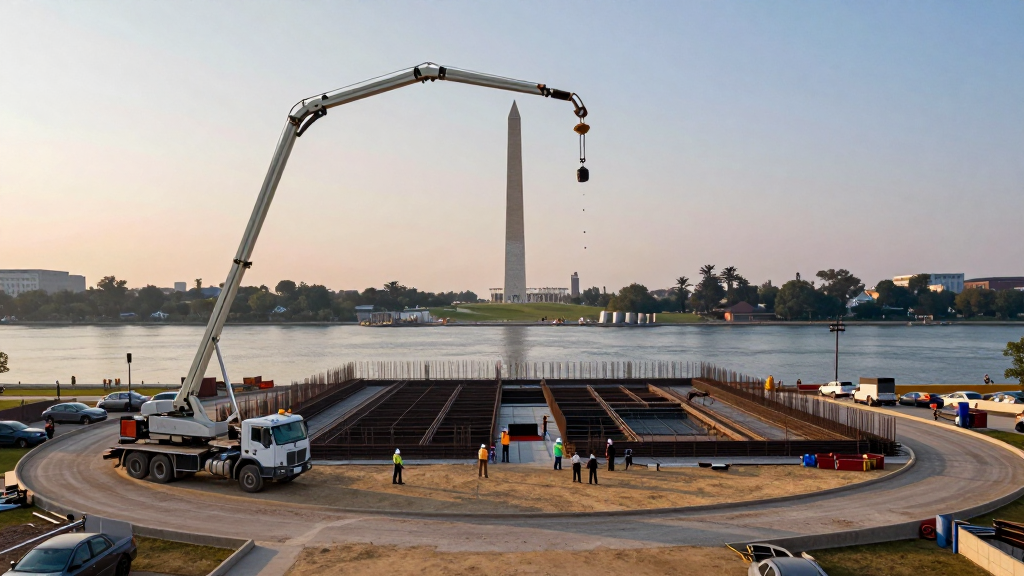
Ray Ochieng has poured concrete in the District for twenty-two years and has never once, he says, been asked to pour something historic. That changed at 5:41 Wednesday morning, when his pump became the first machine to touch the ground of the 250-foot triumphal arch, the monument the administration has been promising since the run-up to the country’s 250th birthday and began construction on the date its lawyers named in court: November 5.
“The pour doesn’t care,” Ochieng said, standing beside the rebar footprint, which is the shape of the arch’s feet and roughly the size of a shopping mall. “Concrete sets in ninety minutes. We had a schedule. The schedule was the date. The date was the argument. So we poured.”
This is the part of the arch story the arguments missed. For four months the arch was a lawsuit with a rendering attached: one suit, then a second suit, a federal commission, questions about airport flight paths, questions about sightlines, questions about whether a thing this tall on the Mall was permitted or merely unchallenged. The administration’s answer to every question was the same, and it was a Tuesday.
THE OPENING DAY, HOUR BY HOUR
- 5:41 a.m. — First pour, per schedule set in court filings
- 6:10 a.m. — Second pour; a park superintendent photographs it from the correct legal distance
- 7:55 a.m. — A tour bus makes an unscheduled loop; driver later says he "just drove past slow, that's all I did"
- 9:30 a.m. — First elevator shaft staked; the elevators remain the single most popular feature of a monument that is currently a hole, a sentiment first recorded at the commission meeting in July
- Noon — Lunch served on the foundation of a monument to the idea that someone, eventually, has to win
The elevators have their own constituency. In October a precinct chair drove two hours to look at a rendering at a Home Depot and delivered the sentence that defined the project — an arch his eighty-one-year-old mother can actually get up is an arch she can love — and the sentiment has held. A YouGov-style survey nobody commissioned but everyone took would find that Americans support the arch precisely in proportion to how much of it they have not yet seen.
The opponents remain opposed, on grounds both legal and aesthetic. The champions remain champions, on the ground that July is coming, and July, as the project’s lawyers have explained with total sincerity, does not negotiate with paperwork. The arch will stand more than twice as tall as the Arc de Triomphe, will wear gilded bronze figures at its base, will keep an eternal flame burning beside the river, and will — this is the detail the skeptics never get over — have an elevator to the top, because the founders, whoever exactly they were on this project, thought about the old.
Ochieng’s pump finished at 1:17 p.m. He said he does not know whether the arch will ever be finished, and that it does not matter, because the concrete he poured will be under a footing either way, holding up either a monument or a precedent, and both, he noted, are load-bearing.
By evening the site had its first souvenir fence, its first jogger taking the long way around it, and its first couple taking a selfie in front of a hole in the ground, in the exact pose people use for the thing itself.