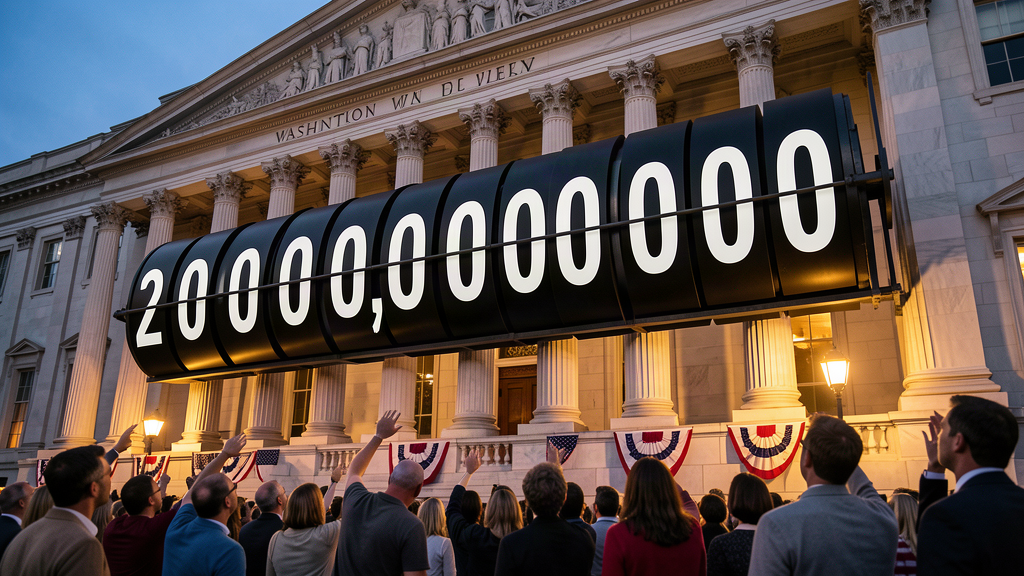
WASHINGTON, D.C. — The United States closed out the 2026 fiscal year with a budget deficit of $1.99 trillion, the largest since the pandemic, and officials from both parties are pointing out that a number this large could not have been produced by a government that wasn’t trying.
The figure, reported by the Treasury Department on Thursday, represents a 12 percent increase in a single year. Net interest on the national debt crossed $1 trillion for the first time, a milestone the nation reached with the quiet confidence of a country that has never once let a bill arrive on time.
Critics were quick to note that the administration came into office promising to shrink the government, and left the first full year of its second term spending more than it ever has. Supporters note that critics have been saying things like that for years, and that the deficit, unlike the critics, is at least telling us something new.
“This is a number with real heft,” said Dale Hutchins, a budget consultant who bills himself as nonpartisan and charges both parties the same hourly rate. “You don’t get to two trillion by accident. Somebody had to sign for all of it. That’s leadership of a kind.”
The arithmetic of the year was straightforward. Military spending, safety-net programs, and interest on the debt all rose, while the administration’s cost-cutting efforts — the famous efficiency drive that once promised to save billions — landed at roughly $170 billion by its own accounting, a figure that made the efficiency drive the smallest spender in Washington.
Lawmakers responded with the measured discipline the moment demanded. One party called the deficit a national emergency and demanded immediate action. The other party called the deficit a national emergency and demanded immediate action. Leadership from both parties then appointed a committee to study which of the two emergencies was the more urgent one.
THE AMERICAN DEFICIT: A NATIONAL SCORECARD
- FY 2026 deficit: $1.99 trillion — highest since the pandemic
- Year-over-year growth: 12 percent, outpacing wage growth, GDP growth, and most things that are supposed to grow
- Net interest on the debt: $1 trillion — now the budget's second-largest line item, behind nothing it has ever publicly acknowledged
- Efficiency savings: $170 billion, achieved primarily by firing people who were not buying the diesel
Markets shrugged, which markets are professionally required to do. Stocks closed Friday essentially flat, the American investor having long ago developed the healthy ability to hear the worst news about the country and check the price of the next thing.
The President, reached at the airport, said the number proved only that America spends bigger than anyone, and that the Chinese deficit, per his sources, is “a total disaster, probably worse, nobody talks about it.”
The 2027 fiscal year began Friday. The Treasury’s projection for next year’s deficit is, at last count, a number that begins with a 2.