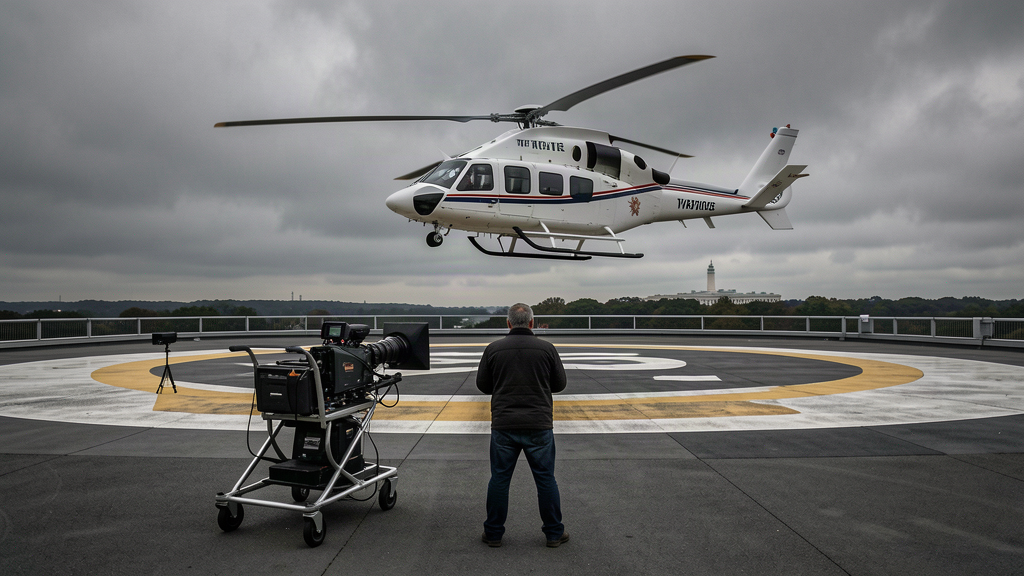
WASHINGTON — The White House television pool, the collection of network cameras that has filmed the President of the United States on every public occasion since 1950, has decided that it will no longer film him, and the administration’s replacement for the arrangement — a 24/7 livestream of the building’s favorite resident, available at no charge — has produced its first official broadcast: a ceremony, at which no one could hear the President speak, in which the footage consists, in the specific, of a helicopter getting louder.
The suspension is, in the words of the five major networks, a “collective effort” to stand with the three outlets the President banned from the White House this weekend — CNN, MS NOW, and Politico — after their reporters’ press badges were, on Saturday, confiscated by the Secret Service. The networks had agreed to share pool duties, meaning one set of cameras, one set of microphones, one unbroken video record of the highest office in the country, carried by news organizations around the world. That arrangement ended at the same moment a new one began, and the new one is called Trump TV.
The first test of the new system arrived at midday Monday, when the President cut a ribbon on a new White House helipad. A ribbon-cutting is a ceremony with a built-in audience problem: the audience is supposed to hear the ribbon being cut, which is a sound, and the ceremony, in the specific, is designed around the event of it happening audibly. Without the pool’s boom mics and audio setup, the President’s remarks were drowned out by the engines of Marine One, which was present for the event in the way that a hurricane is present for a beach house. The White House’s own livestream carried no usable audio of the remarks. The ceremony is now on record. The ceremony could not be heard.
That was, in the specific, the channel’s opening night. The White House is promoting Trump TV with a tagline that reads “Get real-time updates and live events streamed DIRECTLY to your phone. No noise. Just the news that matters most — straight from the Trump Administration.” The “no noise” claim has been evaluated by this newsroom and found to be true in the most literal sense available to a television network. There was, in fact, no noise on the feed. The audio was the engines. The engines are a sound, and the sound was the news that mattered most, delivered directly, and at no cost.
THE TRUMP TV LAUNCH, AS A PRESS RELEASE
- Friday: The President announces, on a social platform, that three news organizations will no longer be permitted inside the building, "effective immediately."
- Saturday: The three organizations' reporters arrive at the building with badges. The badges do not survive the day. This is, in the specific, what a badge is for.
- Monday, morning: The three organizations file a lawsuit. The five networks file a joint statement. The Washington Post files a decision not to publish pool photos until after midnight, which is a decision that is, in the specific, a photo.
- Monday, midday: Trump TV produces its first broadcast. The broadcast is a ribbon. The ribbon is on a helipad. The helipad has a helicopter. The helicopter is loud.
The response from the outside has been, as these things are, unanimous and well-documented. Stephanie Grisham, the White House’s former press secretary, who has spent the last several years describing this building with the accuracy of someone who once worked in the basement, suggested on social media that the new feed resembles the broadcasts of a short list of foreign governments, “to name a few.” Weijia Jiang, a senior White House correspondent, offered what this desk is describing as the most important sentence in the entire episode: “America cannot have state TV. That’s what makes America America.” The sentence is short. The sentence is complete. The sentence is, in the specific, doing more work in a single afternoon than the pool’s microphones have done since 1950.
The President, for his part, says the ban is not “an assault on the Free Press” but a response to “national security” threats — the same justification the administration has used to describe a triumphal arch and a ballroom, which makes the White House’s current building program look less like a construction schedule and more like a genre.
At press time, the White House has confirmed the inaudibility of the ceremony was “a technical matter” and that Trump TV is now streaming the Marine One flyover, live, with the volume turned all the way up. The administration describes this as the future of government transparency. The pool describes it as a helicopter.