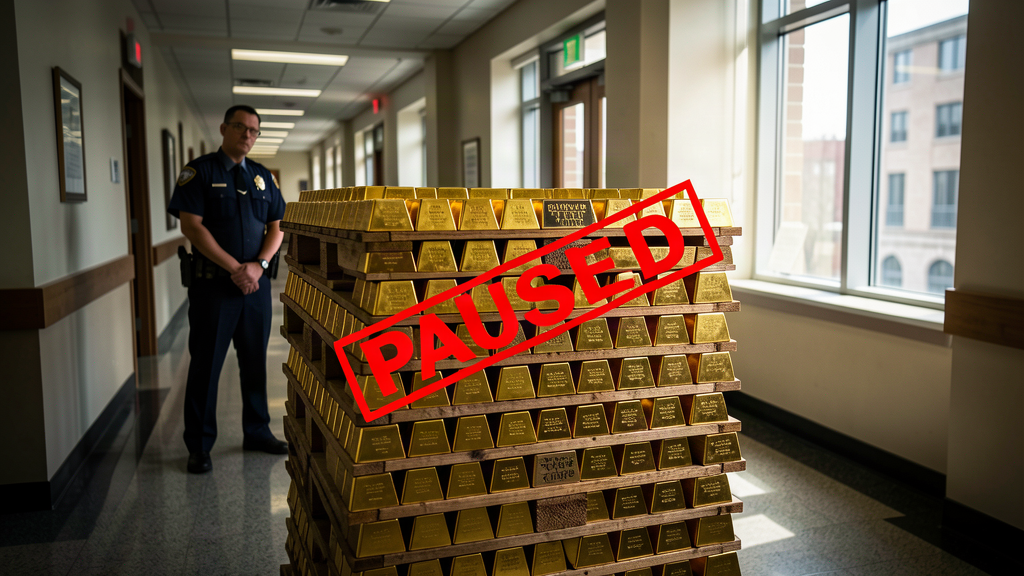
WASHINGTON, D.C. — The White House announced Friday that it will cancel $810 million in congressionally approved funding for refugee services, immigrant detainee programs, and a half-dozen other domestic initiatives, invoking a 1974 provision of the Congressional Budget and Impoundment Control Act that has, by its own press, “practically never been used.”
The administration describes the maneuver as a “fiscal responsibility measure.” The law it relies on is fifty-two years old, has been invoked a handful of times in that span, and requires Congress to do literally nothing to undo it.
“Congress gave this money. We’re putting it in a pause,” said the Office of Management and Budget’s director at a press conference that began eleven minutes early. “That’s not cutting. That’s stewardship. The money is still there. It’s just… temporarily unspendable.”
The legal mechanism, formally known as a pocket rescission, allows the President to withhold funds that Congress has specifically appropriated. Congress can override it by a simple vote in each chamber — a threshold that has, historically, proven as tall as the Capitol dome and about as crowded.
Senate Majority Leader John Thune, who voted for the funding in question, told reporters the move was “unlawful” and that his office was “reviewing its options.” Those options, per a 14-page briefing his staff distributed to members — with a 61-page appendix — include a joint resolution, a court filing, and, in one marginalia note, “talk to Mike.”
The White House press office released a timeline at 6:45 p.m. Friday showing the money moving from “appropriated” to “pending” to a new, previously unseen category labeled “in the holding pattern.” A government spokesperson confirmed the category “does not appear in any existing statute but does appear in the memo.”
The affected programs, per the announcement, include refugee resettlement assistance, a migrant detainee health initiative, and grants to three universities with names the White House declined to specify. Lawmakers on both sides of the aisle have called the move “unprecedented” — a term that, per NBC’s coverage, has been applied to roughly forty separate White House actions this year.
POCKET RESCISSION: HOW IT WORKS (AS OF FRIDAY)
- Law: Congressional Budget and Impoundment Control Act of 1974, Section 1012
- Times used since 1974: fewer than a dozen, per OMB's own count
- How Congress undoes it: vote in both chambers. No filibuster. No cloture. Just votes.
- How often that has happened: "Not that I've seen," said one Senate aide
- What happens to the money: "In the holding pattern," per the 6:45 p.m. timeline
- How long the holding pattern lasts: 30 days, unless Congress votes. The administration has requested a 14-day extension, which no law provides for
Republican members who voted for the funding have described themselves as “comfortable” with the move. “We always knew the money was in a holding pattern,” said one. “We just didn’t know it was our holding pattern.”
At press time, the 30-day window had begun. A joint resolution has been introduced. It has four cosponsors. All four are in different time zones. The money, for its part, remains “temporarily unspendable,” which the White House insists is “a very different thing.”