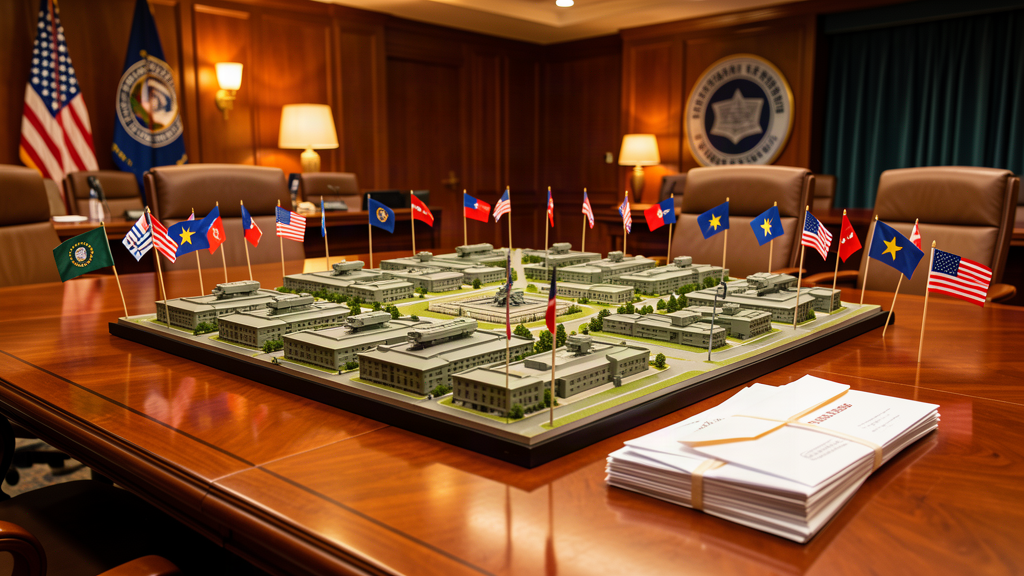
WASHINGTON — The United States has not built a new military base in forty years, which everyone agrees is a scandal, and the Pentagon has now responded with the obvious remedy: letting the states bid on one. Secretary Pete Hegseth called on every governor to submit a proposal for a facility that would host between 15,000 and 25,000 troops, the first “gold standard” installation built in four decades, through a bidding process he promised would be transparent.
The bids are already in, and they are, frankly, inspiring.
Some say a state wins a base because it has the acreage. Others say it wins because it has the railhead. The truth, as always, lies somewhere in a third position I just invented: a state wins a base because it wants one more, and wanting, as any parent knows, is a measurable quantity.
Wyoming’s submission reportedly included a hand-drawn map on poster board, which officials described as “the most honest cartography the department has received since the survey corps stopped using horses.” A delegate from a state that shall remain nameless — but which has a very good highway — argued that the base should go wherever the interstate exit ramp is widest, because logistics is destiny. That’s not pandering. That’s logistics.
And the reframe is right there for anyone who wants it. A state that has spent forty years not getting a base has, during that time, developed something no base can manufacture: patience. The bidding states have been waiting their turn like good Americans, and the reward for waiting is the base. The base is the trophy for not complaining about not having the base.
Hegseth’s speech also unveiled Project Meridian, the study group that will decide what weapons our grandchildren will need, co-directed by Elon Musk, Newt Gingrich, and Anduril CEO Palmer Luckey, with no creative limitations, on any future battlefield, from under the Earth to beyond the moon. Read that sentence again slowly. It is the most ambitious sentence ever written about a battlefield, and it was delivered as a footnote.
THE BID, AT A GLANCE
- Duration of the drought: 40 years — longer than most governors have been alive, and longer than the fax machine has been in service.
- The bid format: One envelope per state. Several states submitted envelopes inside envelopes, which the committee called “thorough.”
- The tiebreaker: If two states tie, the base goes to the state whose delegation brought the best physical model. At least three models included working miniature cranes.
- The religion clause: The new base will include more focus on faith, which the department considers a capability, not a preference.
At press time, the bidding remains open, and one governor has reportedly requested a second window for his bid, on the grounds that his first bid was honest but not yet beautiful. The committee has granted it. At this point, everyone agrees, the process is working exactly as intended.