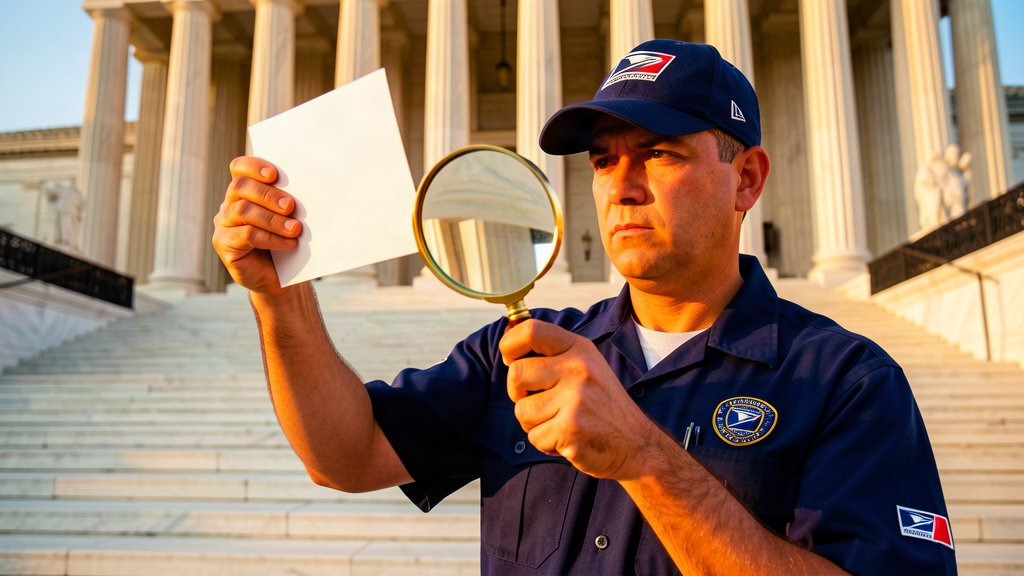
WASHINGTON, D.C. — The administration on Sunday asked the Supreme Court to let the United States Postal Service take a hands-on role in “protecting” mail-in ballots ahead of the midterm elections, just two days after a federal judge blocked the Post Office from doing exactly that. It is, the White House insists, a matter of basic logistics.
“The Post Office already delivers every package, every prescription, and every suspicious coupon offer into the American home,” a senior administration official told reporters, speaking with the quiet confidence of someone who has never once returned a parcel. “If we can trust them with your grandmother’s knitting pattern, we can trust them with the stamp on your ballot. That is not a stretch. That is efficiency.”
The proposal would allow USPS to exert “some control” over mail-in voting — a phrase the administration has described as “flexible” and “robust” and, when pressed for a definition, as “you’ll know it when you see it.”
Critics argue that a government delivery service taking an active role in counting government ballots is a category error of the highest order. The administration responds that critics are “confusing a mailbox with a voting machine,” and that anyone who believes a postal worker could be biased “has clearly never been the one waiting on a delivery.”
A postal union spokesperson, asked for comment, offered a single line: “We deliver what is handed to us. We have been very clear about this.”
The timing is, as expected, impeccable. The midterm elections are now under six months away, and the federal judiciary has already been asked to weigh in on the matter more than once. As one GOP strategist put it, “If the first appeal was about principle, the second was about procedure, and this one is about finishing the job.”
THE POSTAL BALLOT PIPELINE: A LOOK UNDER THE HOOD
- Step 1: The voter mails the ballot to the Post Office.
- Step 2: The Post Office delivers the ballot to the Post Office.
- Step 3: The Post Office verifies the ballot was delivered to the Post Office.
- Step 4: Repeat, as needed, until the Supreme Court says stop.
The legal team behind the renewed appeal argued in court filings that the Post Office’s “decades of experience handling sealed, addressable items” makes it “uniquely qualified” to ensure ballot integrity. The filing, which was not disclosed to reporters in advance, did not specify what, precisely, a “ballot integrity” check would look like, beyond a reference to a “multi-step verification protocol” the administration said is “already fully operational in the mailroom.”
Independent experts described the protocol as “a box.” The administration described it as “a system.”
At press time, a postal worker in Maryland was photographed holding up a ballot envelope with the caption “Just my job, ma’am,” and the image had become, by all accounts, the most shared picture in the country. The Post Office has not confirmed the photo is real. The Post Office has not confirmed the photo is not real.