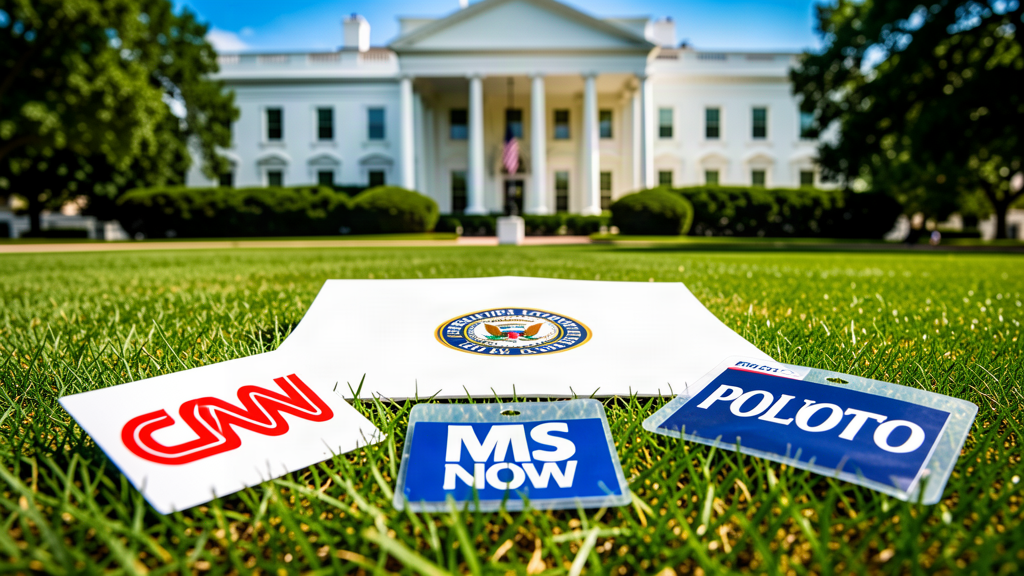
WASHINGTON — A federal judge on Thursday ordered the White House to restore press access for CNN, MS NOW and Politico, and the three news organizations responded with the measured optimism of outlets that have spent the better part of a decade doing this to one another.
United States District Judge Timothy J. Kelly, a Trump appointee, ruled that the President’s directive barring the three outlets from the White House was “most likely unconstitutional” and ordered the administration to immediately restore their credentials. The ruling came the day after the Justice Department argued in court that the ban should stand, telling the judge that “access to the White House is a privilege — not a right” and citing, as has now become standard procedure in matters of this kind, national security concerns of the sort that are described in a filing exactly once and then referenced by lawyers for the rest of the week.
The White House did not contest the outcome so much as schedule it. A presidential spokesperson said the administration was “reviewing the decision” and would “consider all options,” a phrase that in this White House has the operational specificity of “we’ll get back to you.”
"The word 'privilege' has to mean something. If access is a right, then 'privilege' is just a word."
That line is from Dr. Harold Pinfold, a media-law professor at a university he described as “very well known in the state of Delaware,” who said he watched the hearing with the attention of a man who has written three books about the First Amendment and none of them about what happens when the government disagrees with all three.
“The interesting word in the filing was ‘privilege,’” Dr. Pinfold said. “The word ‘privilege’ has to mean something. If access is a right, then ‘privilege’ is just a word. And the interesting word in the ruling was ‘likely.’ The judge did not say the ban was unconstitutional. He said it was likely unconstitutional, which is the judiciary’s way of handing you a result you can appeal on the technicality of probability.”
For the three outlets, the ruling restores a status they describe as “access” and that the White House describes as “a privilege,” which is why, when reporters from the three newsrooms began working out logistics for their return, the question on everyone’s mind was not whether the badges would come back but whether the badges would come back by mail.
A White House official, asked about delivery, said credentials would be “reissued through standard channels for security purposes.” Standard channels, in the current configuration of the executive branch, includes certified mail, a process that takes eleven days in good weather and is therefore, by any operational measure, longer than the ban itself lasted.
HOW TO OBEY A COURT ORDER (AND SIMULTANEOUSLY NOT): A WHITE HOUSE FIELD GUIDE
- Step 1: Say you are "reviewing the decision."</strong>
- Step 2: Say you are "considering all options," without identifying the options, the options, or the option.
- Step 3: Reissue the credentials by certified mail, because the court has not been consulted on the delivery method.
- Step 4: If pressed, note that a privilege, once restored, is still a privilege, and a privilege can be "re-examined."
- Step 5: Call the outcome "a great day for journalism and for the independent judiciary," in that order.
The independent judiciary, for its part, appears to be on the record. Judge Kelly, who has spent this year issuing rulings with the tempo of a man who is finishing a project, was skeptical of the administration’s case at Wednesday’s hearing and signaled the decision would come quickly. It came Thursday, which is, for a federal court, the equivalent of a same-day delivery.
At press time, the three outlets had confirmed the credentials would be returned, had declined to say whether anyone would be in the briefing room when they arrived, and had separately issued statements in which each gratulated the other two on the decision, a formality the press corps has not needed to perform since the 1990s, which is, in the specific, the last time the word “privilege” and the word “right” were arguing in the same building.