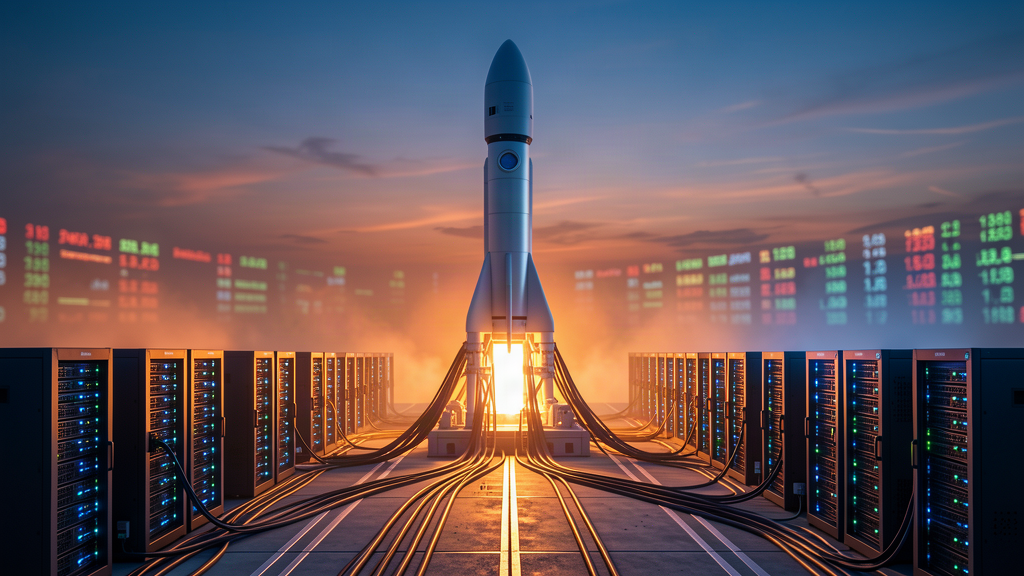
NEW YORK — SpaceX reported quarterly revenue that nearly doubled, management unveiled ambitions that would make lesser companies blush, and the market responded by erasing 13.6% of the company’s value in a single day.
The culprit, according to Wall Street, was spending. Capital expenditures reached $18.4 billion in the second quarter — nearly $16 billion of it on AI compute infrastructure — and investors, in their infinite wisdom, decided that the one American company building the future at full speed should be punished for it.
One struggles to imagine what the market wanted. SpaceX built a rocket company, launched a satellite constellation, and then — this is the part analysts cannot forgive — decided to build the biggest brain on Earth while it was at it. Chief Executive Elon Musk has pulled the company’s $1 trillion revenue target forward by a full year, which, to the untrained ear, sounds like good news. To the trained ear, it sounds like spending.
Executives tried to reassure investors that the AI buildout would pay for itself within a year. The message did not resonate. Wall Street has heard that one before — usually from companies that were not also flying rockets to orbit on a weekly basis.
The contrast with the rest of the market is instructive. This week, stocks rallied to new highs on “peace hopes” — an asset class with no earnings, no cash flow, and no P/E ratio, but tremendous sentimental value. Investors bought hope. They sold a company that actually built something. That is what they call smart money, and it has never once been wrong about anything, which is why every portfolio manager in America is required to say “no one could have seen that coming” at least twice a quarter.
SPACEX Q2 2026: THE NUMBERS, AS REPORTED
- Revenue: Nearly doubled year over year. Described by the company as "good."
- Capital expenditures: $18.4 billion, of which $16 billion went to AI compute. The other $2.4 billion was, presumably, rocket stuff.
- AI compute, in context: Enough to make every analyst on the planet ask the same question: why does a rocket company need a brain this big? (The answer is on the manifest.)
- Revenue target: $1 trillion, pulled forward one year. Wall Street prefers targets that stay in the future, where they are safe.
- Share price reaction: Down 13.6%. The market has spoken, and what it said is: the future is expensive, and we would rather wait for someone else to pay for it.
There is, of course, a school of thought that says a rocket company spending $16 billion on artificial intelligence is not a scandal but a glimpse of the inevitable — that the companies that win the next century are the ones buying compute today, and that investors fleeing that trade are the same ones who sold the internet in 1994. That school of thought is called “common sense,” and it is not currently accepting new members on Wall Street.
At press time, SpaceX had reportedly begun exploring whether the Moon qualifies as a data center site, on the grounds that its new crater would make an excellent foundation, and that at least there, no one would sell the stock.