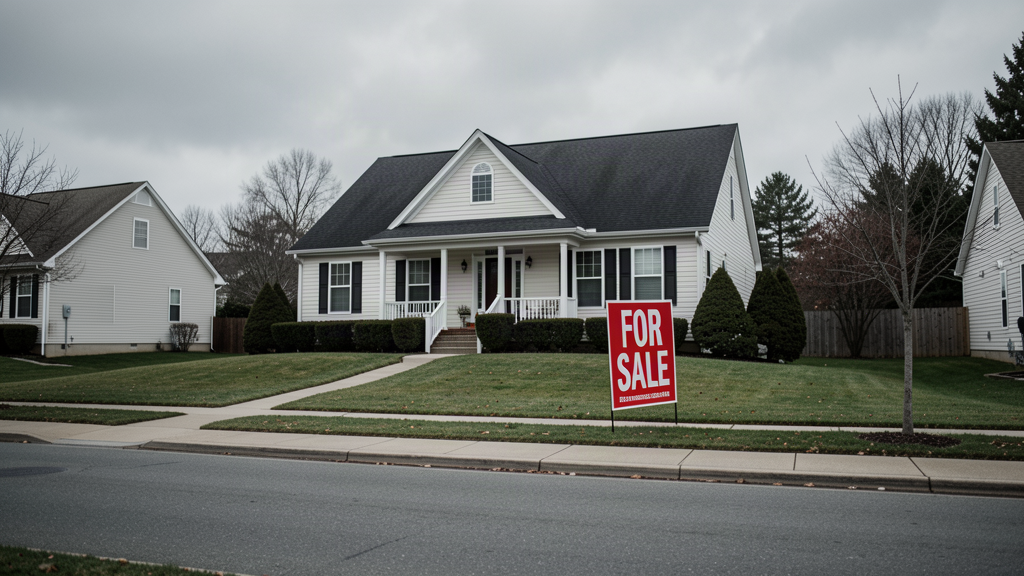
WASHINGTON, D.C. — The United States housing market has achieved something economists once thought impossible: it has become a buyer’s market at a time when there are, for all practical purposes, no buyers.
Home sales and residential construction figures are sliding as homebuyers disappear from the market entirely, according to data released this week by the National Association of Realtors and Bloomberg. The average mortgage rate rose every week in July, starting the month at 6.43 percent and ending at a 2026 high of 6.66 percent. In the first week of August, it jumped even higher to 6.69 percent — a number so specific it sounds like a weather forecast for disappointment.
The result is a market that has achieved a kind of economic Zen: homes are more affordable relative to asking prices than they have been in years, sellers are willing to negotiate, and inventory is piling up. In theory, this should be a paradise for first-time buyers. In practice, the first-time buyers have all moved back in with their parents, who are themselves too underwater on their mortgage to help.
Realtor.com’s revised 2026 price outlook cut home price growth to 1.2 percent — below the expected inflation rate of 3.4 percent. In real terms, this means homes are losing value while simultaneously being too expensive for anyone to buy. Economists call this “Schrödinger’s real estate”: the house is both affordable and unaffordable until someone opens the door and finds a family of four living in the kitchen.
HOUSING MARKET: THE NUMBERS THAT NOBODY ASKED FOR
- 6.69% — current mortgage rate, a 2026 high
- 1.2% — projected home price growth (below inflation)
- 3.4% — expected inflation rate (your money is worth less, but so are the houses)
- 0 — number of buyers who looked at these numbers and said "yes please"
- 1 — number of economists who still think the market will "recover"
The paradox is creating havoc in the real estate industry. Agents who spent the last decade telling sellers to “price high, we’ll get multiple offers” are now telling sellers to “price low, we’ll get an offer.” Open houses have become performance art — agents standing in empty kitchens, narrating the virtues of granite countertops to rooms populated exclusively by other agents and one confused dog that wandered in from next door.
“I’ve been in real estate for twenty-three years,” said Patricia Gonzalez, a broker in Phoenix. “I’ve seen booms, busts, crashes, and corrections. I have never seen a market where the conditions are theoretically perfect and nobody cares. It’s like throwing a party and having the venue, the DJ, and the cake, but all the guests decided to stay home and watch Netflix.”
The numbers tell the story with brutal clarity. The Triad Business Journal reported that buyer demand is at its weakest point since tracking began. The Mortgage Professional America outlet noted that homebuyer numbers hit a record low as the seller surplus widens. In other words: there are more homes for sale than at any point in recent memory, and fewer people who want to buy them than have ever been counted.
The root cause is straightforward: interest rates. At 6.69 percent, a $400,000 home with 20 percent down carries a monthly payment of roughly $1,980 — before property taxes, insurance, and the existential dread of committing to a thirty-year financial obligation in an economy where “job security” is something your grandfather had. First-time buyers, who traditionally enter the market at the lower end, have been priced out not by home prices but by the cost of borrowing the money to buy them.
The Federal Reserve, which controls the interest rate environment that made all of this possible, has offered no indication that rate cuts are imminent. Fed officials have described the current economy as “resilient” — a word that, in economic parlance, means “things are bad but we’re not going to panic about it publicly.”
Meanwhile, the housing market continues its strange dance. Sellers are cutting prices. Buyers are not responding. Inventory grows. Agents commission increasingly creative listing descriptions. One agent in Austin described a three-bedroom ranch as “a rare opportunity to own a piece of American silence” — which is technically accurate, since nobody else is trying to buy it.
At press time, a new Zillow report showed that the average time a home sits on the market has reached 78 days — up from 34 days a year ago. Agents are reportedly spending the extra time learning new hobbies, reorganizing their offices, and, in one memorable case, adopting a office cat.