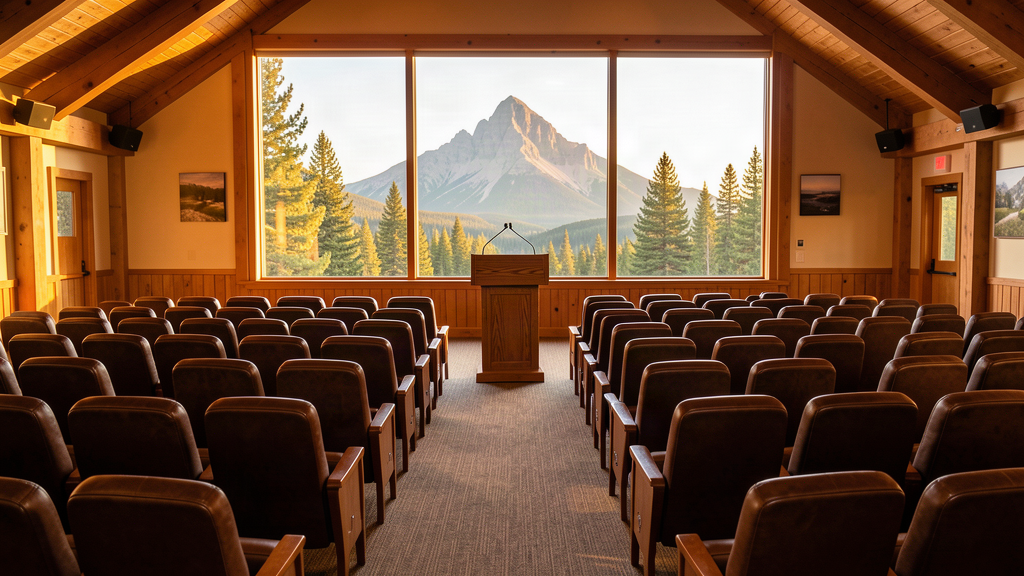
JACKSON HOLE, Wyo. — The Federal Reserve’s annual economic symposium opens Thursday in a mountain lodge with 1,500 chairs, and on Friday morning one of those chairs — the one at the lectern — will be occupied by Kevin Warsh, who will deliver, according to every major market outlet covering the event, his first keynote as Fed chair. The word “keynote” is doing a lot of work in that sentence. A keynote is the speech that sets the key for the rest of the performance. It is, by definition, the moment where the music either starts or it doesn’t.
The market, for its part, is not holding its breath. The market is holding its calculator. The investor calendar for this week is stacked with July’s personal consumption expenditures inflation print, the second estimate of second-quarter GDP, durable goods orders, and a wall of earnings reports — a lineup that has the smell of a week in which the Fed chair’s 45-minute speech is going to be read with the same intensity as a quarterly earnings transcript, because, in the current regime, it is one. Warsh’s Jackson Hole keynote is, functionally, a shareholder call with 1,500 attendees and no questions allowed.
That last part is the part the press releases do not lead with, but it is the part that matters. The Jackson Hole keynote is a monologue. The chair speaks. The room listens. The room does not get to ask why the inflation target is doing what it is doing, or what the central bank’s reaction function would be if oil decided to stop reading the news, or whether the phrase “data-dependent” is still in the vocabulary. The chair says the thing, and then the market, which has spent the week building a probability distribution for every possible thing the chair might say, spends the next four hours collapsing that distribution onto the actual thing that was said.
Bloomberg, which covered the event under the headline that Warsh is expected to clarify his views on how the central bank should react to stubborn inflation, put it the way every wire story on the piece puts it: investors are looking for clarity. Clarity is a word the Federal Reserve uses in the way a restaurant uses the word “fresh” on the fish menu. It is not a commitment. It is a direction.
The economics of the situation are, in the background, genuinely complicated. Inflation is stubborn, which is the Fed’s word for “the problem has not gone away.” Growth is doing something, which is the Fed’s word for “we will not specify what.” The oil market has stopped reading the news, which is the markets’ word for “the price is not where the fundamentals say it should be, and we have stopped pretending.” Into that situation walks a new chair, who has had a few months on the job, a few press conferences, and one July meeting at which the committee split, and who now has to stand in a mountain lodge in front of the entire financial press corps of the developed world and say, in plain language, what the plan is.
Or not. That is also an option. That has, in fact, been the option for most of the last two decades, and the market has learned to price the speech as a signal about the absence of a signal — the size and direction of the surprise in the reaction function, the weight of the word “considerable” in a paragraph about price stability, the number of times the phrase “broadly consistent” appears. The Jackson Hole transcript has become its own asset class, traded in basis points, with a settlement time of approximately four hours.
JACKSON HOLE 2026: WHAT THE MARKET IS PRICING
- Friday, 8 a.m. MT: Warsh takes the lectern. The room holds 1,500 people and a collective breath that will be released on the first use of the word "inflation."
- The word "data-dependent": if it appears, the market will measure its weight. Two uses is neutral. Three uses is a signal. Four uses is a statement, and the statement is "we are not saying what we are going to do."
- The word "considerable": the Fed's favorite adverb. Its presence in a sentence about price stability is the difference between a calm week and a violent one.
- The word "transitory": banned, retired, and yet. If it appears, the market will assume the chair has been reading a 2021 press release, and the bond market will do what the bond market does when it is disappointed.
- Settlement: the market prices the speech in real time, with a full re-pricing of the September meeting by the time the chair has said "thank you, and I'll take questions" (there will be no questions).
There is, for the record, a school of thought — a small one, a nostalgic one — that the Jackson Hole symposium used to be a place where economists went to argue about long questions, in front of small audiences, with no one in the room holding a terminal. That symposium is not coming back. The symposium that is coming, on Friday, is a 45-minute monologue by the most important central banker in the world, delivered in a lodge in Wyoming, to a room full of people whose job is to convert the monologue into a number by lunch.
At press time, the chair’s remarks had not yet been drafted, or had been drafted and redacted, or had been drafted, redacted, and redacted again, which is the Fed’s way of saying the speech is going to be about something. The mountain lodge is being prepared. The lectern has one microphone. The room has 1,500 chairs. And the market, which has already priced the speech before a single word of it exists, is quietly asking the only question the event has ever answered: what is the Fed going to say that it has not already said?