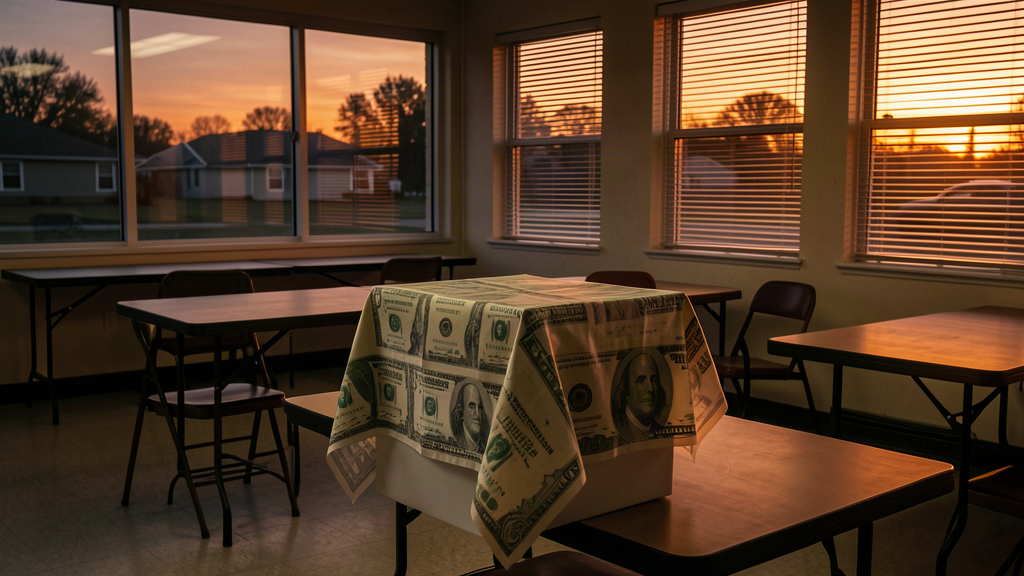
Elon Musk has poured more than $276 million into Republican groups since July, and depending on which count you believe, as much as $366 million across the cycle, making him the largest known donor in American midterm history. On the right, this is called being a concerned citizen. On the left, this is called an oligarch. I have read both takes closely, and I am here to tell you what I have learned in thirty-one years of political opinion: they are describing the same check, and the only disagreement is whose monster the check is fighting.
This is the part everyone knows and no one says. The Democratic donor class has its own list of names, its own zip codes, its own quarterly strategy dinners where a hedge fund manager explains, with a laser pointer, why the monster in Ohio is the priority. The monster in Ohio is a Republican. The monster the Republican donor fears lives in a coastal city and owns a media company. Both monsters are real. Both monsters are funded. The American voter’s job, every two years, is to decide which monster won the fundraising quarter.
I am not neutral about this. Neutrality on money in politics is what the people with the money want you to think is journalism. My position is simple: a legislature where every seat costs a million dollars is a legislature that sells seats, regardless of which party’s auctioneer holds the gavel. I have held this position through six presidential elections, and it has changed nothing, which is itself a data point about how much the position costs.
What the Musk numbers do prove, at least, is that the market has finally priced the product honestly. For two centuries, American politics claimed to be a marketplace of ideas. It turns out ideas have a wholesale price, and the wholesale price of the 2026 Senate is somewhere between a Tesla and a small country. That is not corruption in the legal sense. It is transparency in the economic sense, and the only genuinely new thing about it is the invoice.
The fix everyone proposes — disclosure, caps, public financing, a constitutional amendment, a national day of reflection — has been proposed by every good-government group since 1974, always with the same graph showing the line going up. The line is still going up. The graph is now so steep it is essentially a flagpole, and both parties are climbing it, each convinced the other side will reach the top first.
At press time — and I use the phrase advisedly, because this column runs the morning after the Musk story and the morning after is when all political money is reported — the Senate Leadership Fund confirmed it will spend more before November 3. The Democratic counterpart confirmed the same within four hours. Four hours. That is the speed of American agreement, and it is faster than anything Congress has done since 2001.