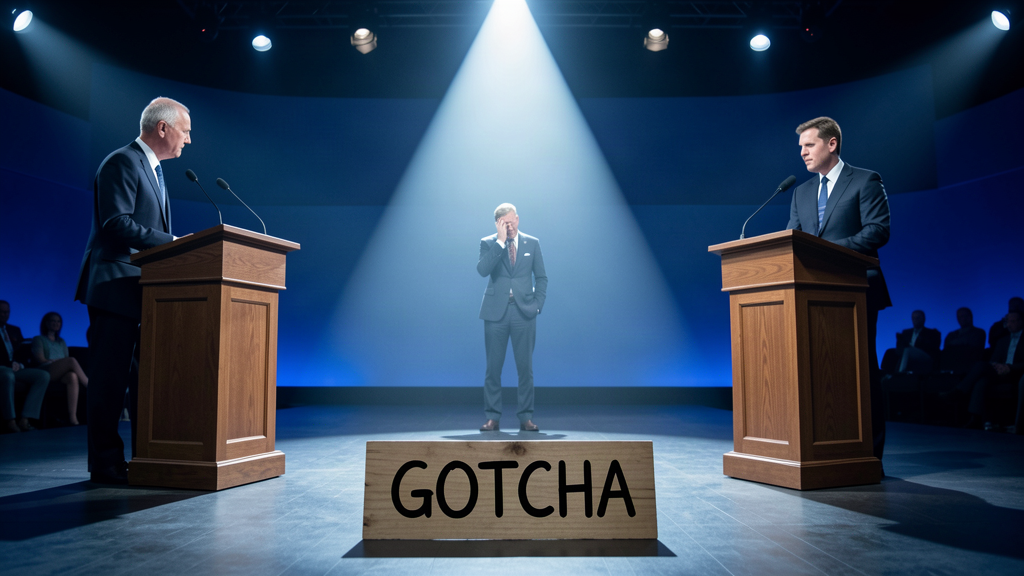
DETROIT, Mich. — There is a particular kind of political statement that does not win the argument, does not advance the policy, and does not move the poll by even a single decimal point, but which somehow captures, in a single breath, the exact temperature of a race that has been circling the same issue for six weeks. In the Michigan Senate race, that statement has been “I resist the idea that we should play this cancel culture gotcha game that tells us who we can’t talk to,” said by Democratic nominee Abdul El-Sayed on a debate stage, and since repeated, in one form or another, at nearly every appearance.
The line has been widely criticized, by columnists on the same side of the race as the man who said it, who have argued that the problem was never the gotcha game but the streamer himself. That criticism is, on the merits, largely correct. But it misses the point, which is that the line is doing something far more interesting than defending Hasan Piker. It is, by accident, describing the actual state of the race.
THE GOTCHA GAME: FIELD NOTES
- The phrase: "Cancel culture gotcha game." Coined under debate lights, repeated verbatim at every stop since.
- The thing being defended: A relationship with a streamer who "streams eight hours a day, seven days a week," per the nominee's own accounting.
- The counter-argument: That the issue is the streamer, not the game. (Correct.)
- The unintended result: A phrase that now describes the entire race, by all parties, including the party using it.
The reason the line lands, and lands on its own side, is that the “gotcha game” is not a metaphor the nominee reached for in the moment. It is the accurate, unglamorous description of a race in which both parties have spent more airtime interrogating a single relationship than they have spent on the actual content of the ballot. The Republican opponents, in their own words, have made the streamer “a major point of attack.” The nominee has made the attack on the streamer his primary point of attack. What remains, after four weeks of this, is not a policy race but a shared vocabulary — a single, very specific phrase that both sides now use, and both sides mean, and neither side can stop.
This is not a new phenomenon. American politics has, for decades, been built on a small number of phrases that do more work than the candidates who deploy them intend. “Ground zero.” “Bridge to nowhere.” “The gotcha game” is the newest entry in that canon, and it will outlive the race, the nominee, and the streamer, because it describes something that is true and not going away: that a lot of what passes for a political argument is, at the bottom, a game, and the people who name the game are, usually, the ones who have already lost it.
At press time, the phrase had been adopted, in a form, by at least one candidate on the other side, who used it to describe his own side’s questioning of a different relationship, which, as one local observer noted, “means the gotcha game is now a shared infrastructure, and no one is going to be able to stop using it.”