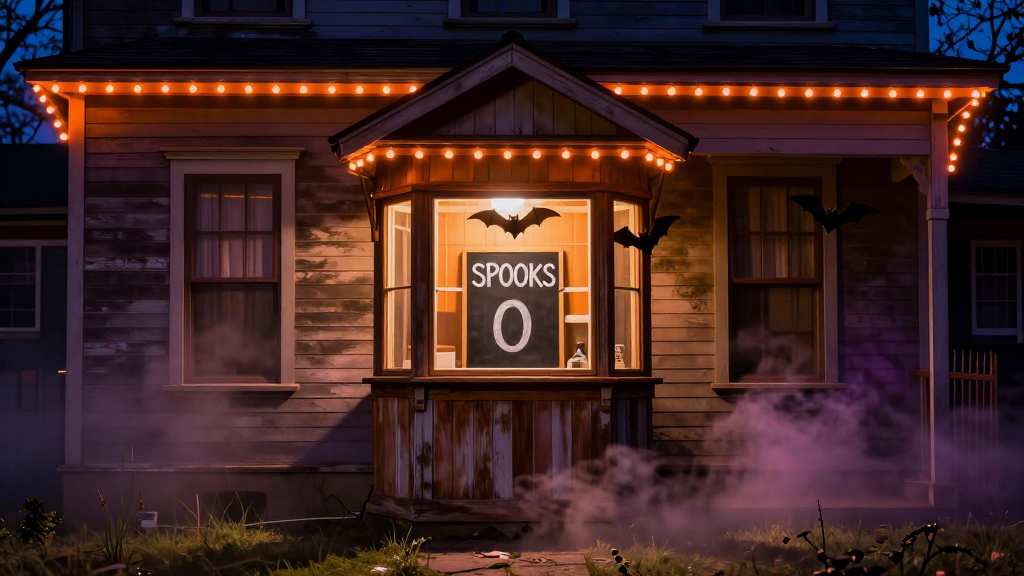
This has been a week in which a company priced the risk of human extinction at about two trillion dollars and the market called the number attractive, and in which the federal government lost twelve billion dollars on a chipmaker in a single afternoon and pointed out that the loss was unrealized. So tonight, on Halloween, I would like to say something loving about the haunted house.
The haunted house is a business that tells you, before you pay, that it will scare you. Then it scares you. Nobody sues. Nobody posts a one-star review because the fright failed to materialize; the reviews are mostly people naming the actor who grabbed them, the way you would compliment a pitcher. This is called a completed transaction, and you can feel how rare it is by reading the words.
Consider the fine print of everything else you own. Your phone plan has a fee shaped like a question. Your membership renews by agreement you agreed to, your grocery store prices items for the app and not the shelf, and the airline sells you a seat, then a window, then the illusion of a window. The haunted house charges forty dollars and delivers the thing printed on the sign, plus a corpse in a hearse that costs extra and says so.
Marla Ketchum has run a haunted funeral parlor outside Paducah, Kentucky, for thirty-one years, and she has thought about the comparison more than once. “We tell them it’s scary before they pay,” she said. “Try that at a bank.”
Her scare is fake, and you know it’s fake, and you enjoy it precisely because the arrangement is honest. The skeletons admit they are actors. The fog machine is loud on purpose. The chainsaw budget shows. And there is a posted exit — the only American business model that advertises where the exit is and genuinely means you to use it.
The alternative is the year we actually live in, where the scares are real and unbudgeted: a portfolio that turns out to be a mood, a chatbot with an appendix on human survival, a government stock pick with a worst-day record since 1974. Those attractions charge no admission. They take your money first and open the coffin later, with a quarterly call to explain the hinges.
So go tonight. Stand in the line that snakes around the block past the parking lot, hand over forty dollars to a teenager in a rubber mask, and let him do the job he was hired for. Your heart rate will spike. You will pay. You will thank him. Somewhere in that transaction is the entire American bargain — risk taken knowingly, price posted, fear delivered — and if it survives only inside a plywood mansion with a fog budget, then I am telling you where the last honest business in America keeps its books.
At the very least, the skeleton has no IPO.