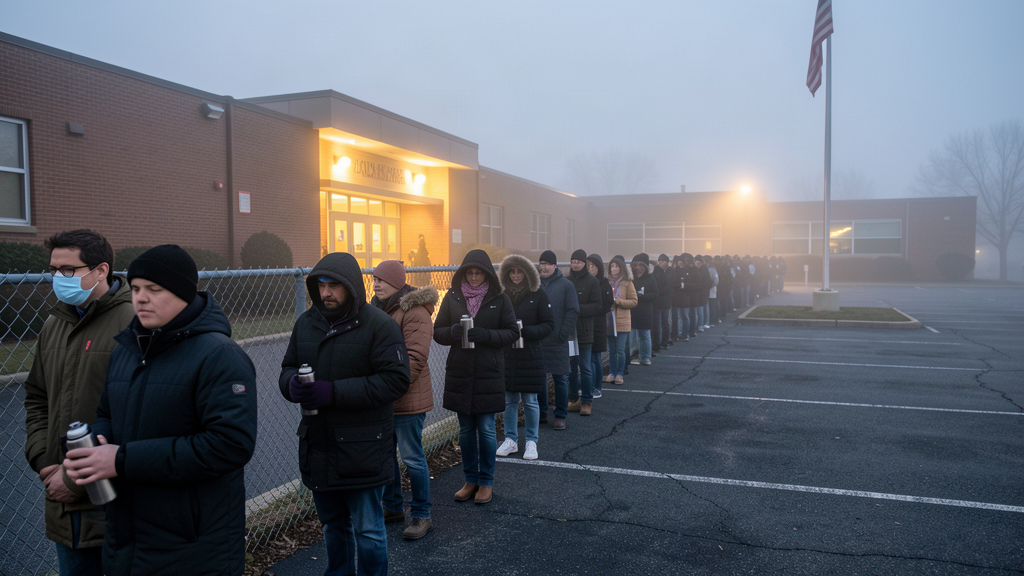
I have covered enough elections to know that every line outside a high school gym is, to the person standing in it, proof that the other side is terrified. What I did not know until this week was the length of the lines, because the numbers this time are enormous, and everyone is trying to read them like a tea leaf that happens to be on fire.
The Associated Press analyzed early voting this week in the states most likely to decide the United States Senate. Texas is running 74 percent ahead of the same point in 2022. Kansas has more than doubled. Maine, North Carolina and Ohio are up more than 30 percent. Nationwide, more than 13 million people have already voted by mail or in person, against 9 million at this point four years ago.
Both parties looked at this and found, somehow, that it proved their thing.
Democrats point out, accurately, that the surge comes in states where they are trying to flip Republican-held Senate seats, and that Republicans are accounting for a smaller share of the early vote than they did four years ago. Republicans point out, also accurately, that their side has discovered early voting after four years of describing it, in their own words, as a scheme, and that the polling places are calm, and orderly, and theirs. I have never before watched a party discover absentee ballots at full speed in October, but the forklifts are visible, and credit is due where credit is due.
Kansas tells the whole story in one overtime frame. Donald Trump carried the state by 16 points in 2024. This year, Republicans pulled their money out of a once-competitive North Carolina race and dumped close to $12 million into Kansas to re-elect Senator Roger Marshall against Democrat Adam Hamilton. Trump held a rally in the state on Monday. More than 55,000 Kansans have already cast ballots, against 27,000 at this point in the last midterms. A state the maps had filed away as furniture is now a live circuit, and both campaigns are feeling the voltage.
Here is what the numbers actually say, stripped of the jersey: anxiety shows up early. High gas prices show up early. A cost of living that stopped feeling like a temporary condition shows up early. The people standing in those lines at 6 a.m. are not optimistic, exactly. They are informed, which in an election is the same posture with better posture.
The campaigns know this too, which is why each of them spends October trying to claim the lines rather than fill them. Turnout has become a scoreboard both teams watch while the game is still being played, a spreadsheet read aloud as poetry.
I would like to propose a different reading: a long line is a long line. It is one of the few American institutions that still works the way it was built to work. It proves nobody’s thing except this one — that enough people were worried enough to wake up before sunrise, stand in the cold, and wait their turn on purpose.
Kansas, this week: 55,000. Kansas, four years ago: 27,000.