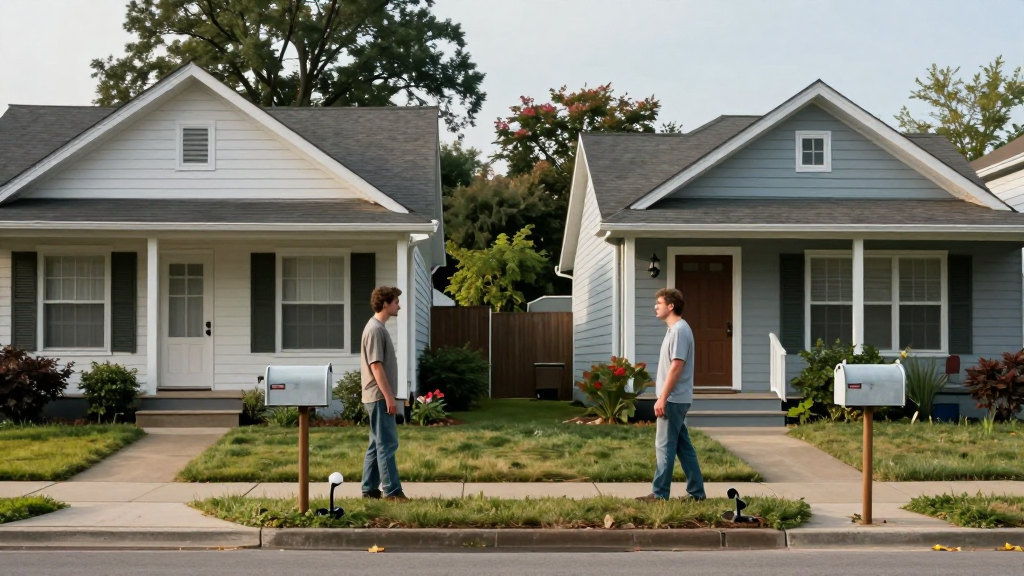
From my porch, the election looks like this: 41 houses, nine yards with signs, two flags no flag code recognizes, and the Hendersons’ plastic-flamingo situation, which has become political by accident because one of the flamingos is holding a small American flag and the other one isn’t, and nobody on this street can agree which flamingo that makes them.
Tomorrow 160 million Americans will make a choice about the direction of the country. Roughly half of the choices will be, to the other half, an event of historic misjudgment. This is not a crisis. This is the arrangement. The entire point of the American system, the one feature the rest of the world copies badly, is that the argument never has to end — it only has to have a count. And on Wednesday morning, whoever you were hoping for, somebody on your street will be disappointed in a way they will not get over by lunch.
So here are the porch rules, which I have refined over thirty-one years on this street and two decades of column writing. They are not about politics. They are about the next thirty years of borrowing a leaf blower.
Rule 1: Wave first, and wave small. The election-eve half-wave is a genre of American gesture all its own: the hand rises, the elbow stays in, the face says “I see you, I choose the fence-less future, but let’s not make this a moment.” Small waves are deniable. Full waves commit you to a conversation neither house can survive before coffee.
Rule 2: The mailbox is sovereign territory. Stickers on a mailbox are not an argument; they are weather. You do not have to agree with the weather. You do have to stand in it. Covering a neighbor’s sticker is vandalism, and covering your own is worse, because then on November 4 you will look at a bare mailbox and grieve the year you had a mailbox with a statement on it.
Rule 3: No one may invoke the result at the compost. The compost pile is neutral ground, recognized as such by every street with a homeowners association and most streets without one. The county’s “shared resources” language is the last constitution this neighborhood actually respects. If the returns arrive while you are both turning the pile, you say “afternoon,” and you turn the pile.
Rule 4: Practice the concession sentence now. Whichever way Tuesday goes, some version of this will be true: “Well, the people spoke.” Say it in the mirror twice. Once for the side that wins and has to resist, at the hardware store, explaining why the result was obvious. Once for the side that loses and has to resist, at the same hardware store, explaining why the result was illegal. The sentence ends both conversations.
Rule 5: Tomorrow night, turn the signs down. Not off — the sign was a commitment, and we honor commitments, even the ones we’ll want to renegotiate by 2028. Just angle them toward the house, like the street is going to bed. The yard is not a courtroom. The yard is a yard, and the trial is over, and the jury was everyone.
This street has disagreed out loud for thirty-one years: about the development at the old cannery, about the speed limit, about whether the elementary school should have a turf field, and about a dozen mayors, four of whom were not actually running for anything. The Hendersons and the Nguyens have not fully spoken since the fence thing of 2014, and even that thawed when the sump pump went out, because flooding is nonpartisan and the Nguyens have a wet-vac.
Tomorrow the country counts itself and gets a number, and the number will be wrong by the standards of everyone who disagrees with it, which is half of everyone, which is the system working. The flags will stay up — both kinds, including the flamingos. And on Wednesday, from my porch, the street will be exactly what it has always been: eleven dog owners, four empty-nesters, the corner family with the basketball hoop, and 41 houses, holding, at arm’s length, the same fragile American thing: a wave that says we still have to borrow the leaf blower.