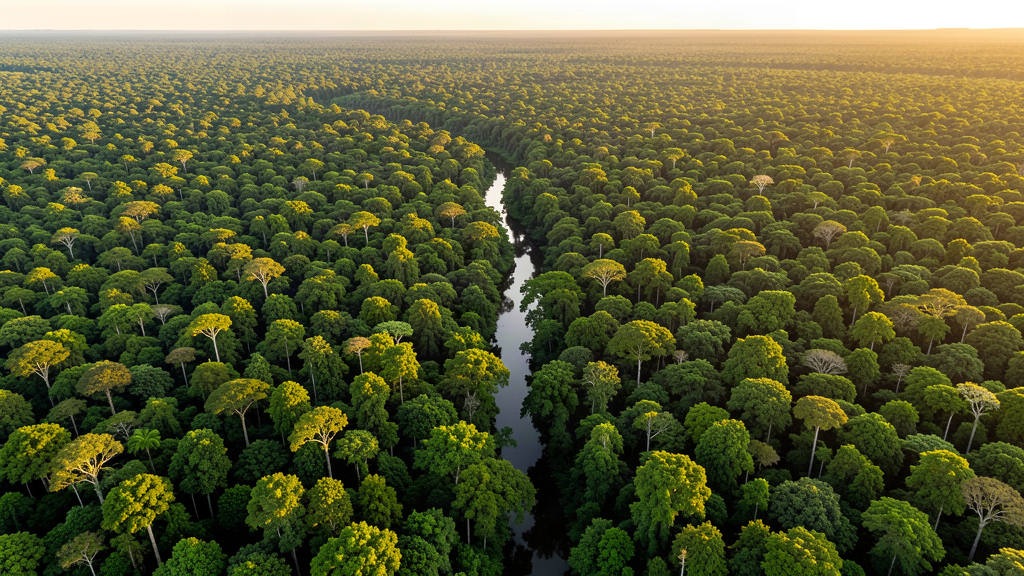
BRASÍLIA, Brazil — In a development that has stunned climate scientists and delighted economists, Amazon deforestation has plummeted 38 percent in the first half of 2026, reaching a historic low that puts Brazil on track for the lowest official amount of forest lost since satellite measurements began nearly four decades ago.
The numbers are remarkable: between January and June 2025, a total of 2,090 square kilometers of Amazon rainforest were cleared. In the same months of 2026, that figure dropped to 1,295 square kilometers — a decline so steep it makes the previous year’s deforestation rate look like a clearance sale at a lumberyard.
The credit, according to analysts, belongs not to environmental policy or international pressure, but to the invisible hand of the free market. Brazil’s Real-Time Deforestation Detection System recorded just 2,874 square kilometers under deforestation alerts for 2026 — the smallest area in the system’s entire historical series. The Amazon, it turns out, is being saved by the same economic forces that spent the last forty years tearing it apart.
The mechanism is elegantly simple. As global demand for sustainable products has risen, standing forests have become more economically valuable than cleared land. Carbon credit markets, ecotourism, and the pharmaceutical industry’s growing interest in rainforest-derived compounds have created a financial ecosystem where a living tree generates more revenue over time than a dead one does in a single harvest. The Amazon hasn’t been saved by altruism. It’s been saved by a balance sheet.
AMAZON DEFORESTATION: BY THE NUMBERS
- 38% — decline in deforestation in early 2026 vs. 2025
- 1,295 sq km — area cleared in H1 2026 (down from 2,090 sq km)
- 2,874 sq km — total area under deforestation alerts (historic low)
- 38 years — length of Brazil's satellite monitoring program
- 0 — number of trees that were consulted about their new economic value
Environmental groups have cautiously celebrated the numbers while warning that the trend could reverse. “This is genuine progress, but it’s progress driven by market forces, not by permanent legal protections,” said Marina Silva, Brazil’s Environment Minister. “Markets change. Carbon credit prices fluctuate. The moment it becomes more profitable to cut the forest than to keep it, the chainsaws come back.”
The concern is not hypothetical. Brazil’s deforestation rate has historically moved in cycles — sharp declines followed by rebounds when commodity prices shift or political winds change. The current dip coincides with a global surge in carbon credit demand, driven by corporate net-zero pledges and European Union regulations that require companies to offset their emissions. When those pledges expire or those regulations change, the economic incentive to protect the forest could evaporate overnight.
Still, the data has provided a powerful counter-narrative to years of grim Amazon reporting. Between 2019 and 2022, deforestation surged under policies that critics described as “open-for-business” environmentalism. The current reversal suggests that market-based conservation can work — provided the market continues to value what it’s conserving.
The scientific community has responded with measured optimism. “A 38 percent decline is significant by any measure,” said Dr. Thomas Lovejoy, a biodiversity researcher at George Mason University. “But we should be careful about declaring victory. The Amazon is a system of extraordinary complexity, and deforestation rates are one metric of many. Reforestation, biodiversity, indigenous land rights — those are the deeper measures of whether the forest is truly recovering.”
For now, the trees are winning. The Amazon’s carbon-absorbing capacity, its biodiversity, and its role as a global climate regulator are all trending in the right direction — driven not by the good intentions of policymakers, but by the cold arithmetic of supply and demand.
At press time, the Amazon rainforest was reportedly “cautiously optimistic” about its financial future but remained concerned about the long-term viability of a conservation model that depends on humans continuing to agree that trees have value.