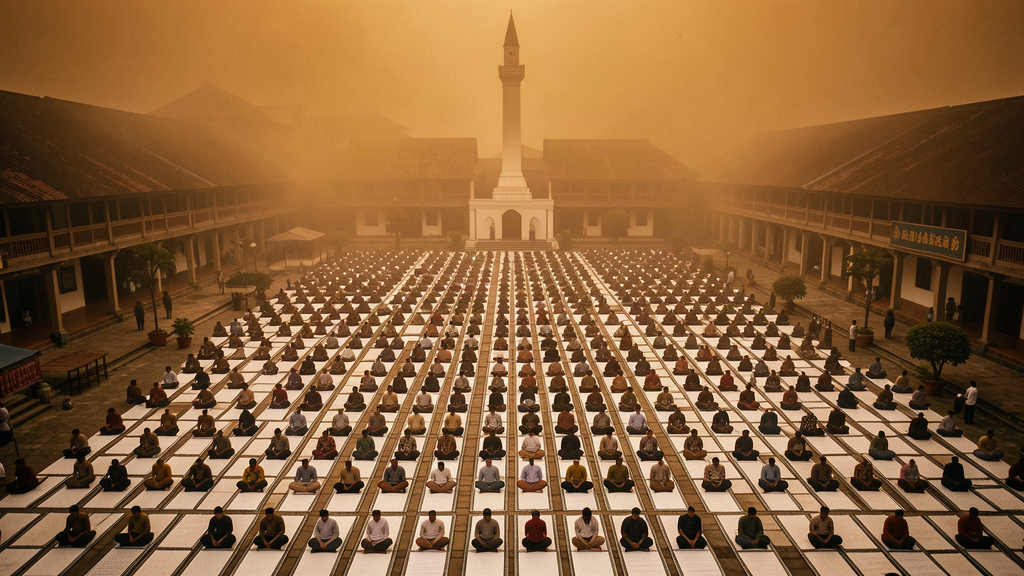
PALEMBANG, Indonesia — Roughly 3,000 residents of Palembang, the capital of South Sumatra province, gathered in the courtyard of the governor’s office on Tuesday to perform a special Islamic prayer for rain, a ritual known as salat istisqa, and they prayed shoulder to shoulder under a sky that was, by every measure, no longer a sky — it was a ceiling, a ceiling made of smoke, a ceiling that the fires in the forests and peatlands of central and western Indonesia had been building, plank by plank, for weeks.
The Associated Press reports that drought, strong winds, and dry vegetation have complicated containment efforts, and that aerial firefighting operations have been intensified as the haze spreads, in some cases beyond the country’s borders. What the AP report does not say, because the AP report is not equipped to say it, is the part that actually happened on Tuesday: that the most advanced atmospheric engineering project in the province that morning was 3,000 people, on prayer mats, facing east, asking.
There is a word the meteorologists use for what the sky over Palembang has become, and the word is “haze,” and there is a word the residents of Palembang use for the same phenomenon, and the word is “the fire’s weather,” and both words are accurate, and the difference between them is roughly the distance between a press release and a life.
The salat istisqa is, for the record, an ancient practice — a communal supplication for rain, performed when the rains fail, in this case a failure that has scorched wide areas of forest and peatland and blanketed cities in what the NPR coverage describes as choking smoke. Peatland fires are their own category of atmospheric event, and it is worth pausing on that, because peat is not a forest. Peat is a sponge. It is a sponge that has been absorbing carbon for thousands of years, and when it dries out, and when it catches, it does not burn the way a tree burns. It burns the way a bank vault burns — slowly, deeply, and with a smoke that does not behave like smoke. It does not rise. It parks.
A provincial official, speaking to reporters at the edge of the courtyard before the prayer began, was asked whether the authorities had a secondary plan in the event that the primary plan did not produce measurable precipitation. The official, who has been coordinating the response since the first blazes were spotted, took a breath, and said, “The secondary plan is the aerial bombardment of water, and the third plan is a more formal prayer, with a larger crowd, and we understand that the crowd size is a variable the sky responds to.”
PALEMBANG HAZE: A SITUATION ASSESSMENT
- ~3,000 residents gathered for the *salat istisqa* — the largest single-rain request on record for the province this season.
- Prayer mats: arranged in rows, shoulder to shoulder, in the courtyard of the governor's office. The governor's office, for the record, is the most important building in the province, which makes it a very logical place to ask for rain.
- Aerial firefighting: intensified, per the national disaster agency, which is the government's way of saying the planes are going back out, which is the government's way of saying the fires are still there.
- The haze: has reached hazardous levels in parts of the country, and, in at least one reported case, has crossed a border. Haze is the one weather event that does not respect a passport.
- Next step: a larger prayer, with a larger crowd, if the current one does not produce measurable results by Friday.
The question that has occupied the provincial meteorological office since the first smoke column was photographed is, as far as the office will say publicly, an open one: whether the prayer and the aerial water drops are complementary operations or competing ones, and whether the sky, in its infinite wisdom, is capable of distinguishing between a bucket of water dropped from a helicopter and a request made on a prayer mat. The office has declined to commit to an answer, which is the meteorological office’s way of saying it does not know, and also its way of saying it does not want to be on record with an answer it might later have to walk back in the face of a rain gauge.
Residents of Palembang have, in the meantime, done what residents do when the sky is not cooperating: they have adjusted. The markets open at the same hour. The school buses run on the same route. The difference is that everything is now conducted under a low amber ceiling, and the people who live under that ceiling have, over the past several weeks, developed a kind of local expertise in reading the color of the air — a skill that, as one resident put it, “I did not have before, and I will never not have again.”
At press time, the rain had not come, the prayer had ended, and the governor’s office was preparing what the provincial government described as “a follow-up atmospheric engagement,” scheduled for Thursday, which is to say: the prayer is on for another round, the planes are on for another round, and Palembang, as it has done for weeks, is continuing the work of a city that has decided, in the face of a smoke ceiling, to keep asking — politely, in rows, and with the full weight of 3,000 people behind the request.