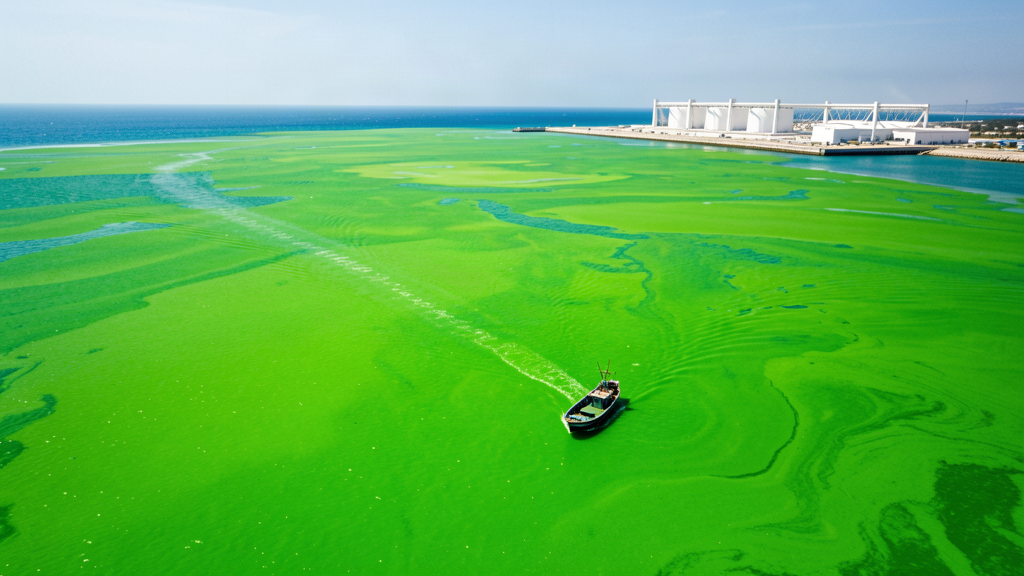
TEL AVIV — A microscopic organism so common it is found in nearly every body of water on Earth has, for reasons no one fully understands, decided that this was the week to shut down the desalination plants that supply the majority of Israel’s drinking water.
Five of the country’s six coastal desalination plants were knocked offline this week by a massive bloom of microalgae in the Mediterranean, CNN reported, leaving one plant running north of Tel Aviv and prompting a national conversation about what to do when the smallest thing in the ocean becomes the biggest problem on the coast.
The organism responsible, researchers said, is a cyanobacterium from the genus Synechococcus — a species that, by most estimates, makes up a substantial share of the ocean’s photosynthetic life and is, on any given day, present in bigger numbers than there are human beings on the planet. It has been doing this for roughly three billion years. It was, in the words of one marine biologist, “doing fine” until it wasn’t.
“It’s not that the algae did something new. It’s that for the first time, someone built a very sophisticated system that happens to be located directly in front of it.”
The exact species within the genus has not yet been identified, and the specific cause of the bloom’s sudden intensity is under study. Scientists said the conditions this week — a combination of water temperature, nutrient availability, and calm seas — created what one described as “the perfect bloom,” a phrase that would ordinarily be used to describe a garden.
The desalination plants process seawater by forcing it through fine membranes, a process that, under normal conditions, removes nearly everything in the water except the water. The algae, however, are small enough to clog those membranes en masse, and dense enough that the plants’ intake systems effectively stopped functioning. Engineers have been flushing and re-cleaning the systems in a process one described as “aggressively trying to out-clean an organism that reproduces every twenty minutes.”
THE BLOOM, BY THE NUMBERS
- Plants offline: 5 of 6
- Organism responsible: *Synechococcus*, a cyanobacterium
- Time to double its population: roughly 20 minutes
- Time it has been doing this: approximately 3 billion years
- Plans in place to handle it: under review
The one remaining plant, running north of Tel Aviv, is now the subject of considerable national attention. Officials confirmed it was operating and declined to comment on the possibility that it, too, could be affected by the bloom. Residents in the surrounding area reported no change in water pressure, a detail that has done a great deal for morale.
At press time, a research team had announced it would publish its findings on the bloom’s cause in the coming days, and a government task force — the third such task force convened on a water-related matter this year — had been asked to “review the situation.” The Synechococcus, for its part, showed no sign of slowing down.