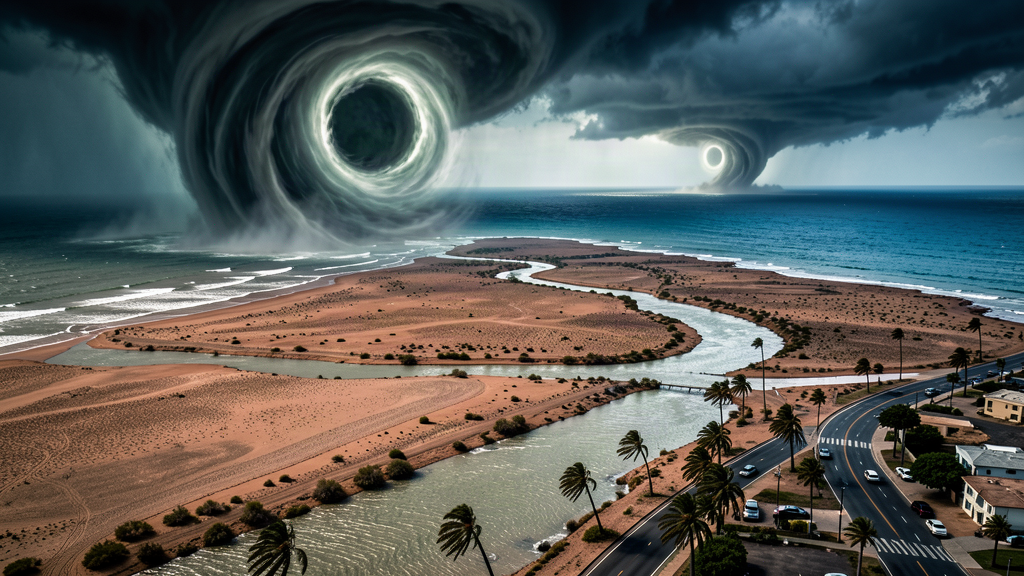
PUERTO SAN CARLOS, Mexico — Hurricane Polo, one of the most intense hurricanes ever recorded in the eastern Pacific, bore down on Mexico’s Baja California peninsula Monday and made landfall with the kind of damaging wind and life-threatening flash flooding that forecasters have been warning about for a week, while its younger brother Nolo, a few days weaker and a few thousand miles to the east, did the thing hurricanes do, which is threaten Hawaii.
Polo, which recorded 892 millibars on September 22 — the second-most intense measurement ever in the eastern Pacific, behind only a storm with a similar name — arrived in Baja California Sur with 140-mile-per-hour winds, streets flooded in the coastal town of Puerto San Carlos, and the National Hurricane Center’s usual description, “life-threatening,” applied to the wind, the flooding, and, in the forecasts for the days ahead, the mudslides, which in this part of the world are what the flooding becomes once the rain finds the hills.
The peninsula, a long desert strip of Mexico that is home to a small number of cities, a large number of cattle, and one of the world’s busiest military-to-tourist border crossings, took the hit the way long, thin places take hits: along its whole length, at once, with no interior to hide in.
"The whole length, at once, with no interior to hide in."
Meanwhile, Nolo — a name that has become, in the weeks since it formed, the weather equivalent of a sibling nobody asked for — has drifted further from the Hawaiian Islands, though not, forecasters emphasized, far enough to cancel the threat. Parts of the Big Island could still receive up to 20 inches of rain, which is the amount of rain a place like the Big Island has not been expecting to receive all at once, which is why the word “life-threatening” has appeared, this season, in nearly every forecast bulletin, which is why the National Hurricane Center has a style guide.
The two storms, moving in the same general direction on the same general ocean, have given meteorologists what they describe as a “twin setup,” which is the forecasting term for “two problems, one news cycle.” The practical upshot for travelers, which is the only upshot most people will track, is that flights out of the Baja are being rerouted, flights into Hawaii are being delayed, and the two events are being covered on the same page of the same newspaper for the same reason: because the Pacific, this season, is having a lot to say.
POLO AND NOLO, SIDE BY SIDE
- Pressure: Polo at 892 millibars, the second-lowest ever recorded in the eastern Pacific; Nolo, a few days and a few hundred millibars higher
- Winds: Polo at hurricane strength at landfall; Nolo at the strength of a storm that is still, by the forecasters' own account, "capable of causing life-threatening flooding"
- Location: Polo on a desert peninsula with no interior; Nolo over open ocean with a small island chain as its next appointment
- Names: both from the Pacific's rotating list, which, as with the Atlantic's, runs out of letters every few years and is currently on a second round of the alphabet
At press time, Polo was moving inland, Nolo was holding its distance, and the National Hurricane Center was issuing its next bulletin, which, in the center’s own words, was “the next bulletin,” a fact that will continue to be true, at intervals of roughly six hours, until the Pacific decides it has finished speaking.