At 4 a.m. Eastern, a man in Toledo, Ohio, called a radio show to ask a simple question: can a province leave, and if so, is it for sale? The host said no. The man said, “Then why are they voting?” By noon, the answer had arrived by the hundreds of thousands, in ink.
Albertans voted overwhelmingly to remain in Canada, rejecting a proposal to begin a process toward a referendum on independence — a ballot question about a ballot question about the country, which is the most Canadian act in North American history and the least American one. Prime Minister Mark Carney said the province “chose unity”; the Guardian notes the result is a win for Carney’s national-unity push. The advance poll, held in advance of the advance, drew 174,000 ballots in a single day.
Americans, to be clear, are not upset. Americans are confused, which for a nation that has never asked a single jurisdiction whether it wants to stay is the natural response. On Monday night in Red Deer, Alberta, Gord Enns, a 68-year-old retired petroleum accountant, took a series of phone calls from people who wanted to understand the procedure.
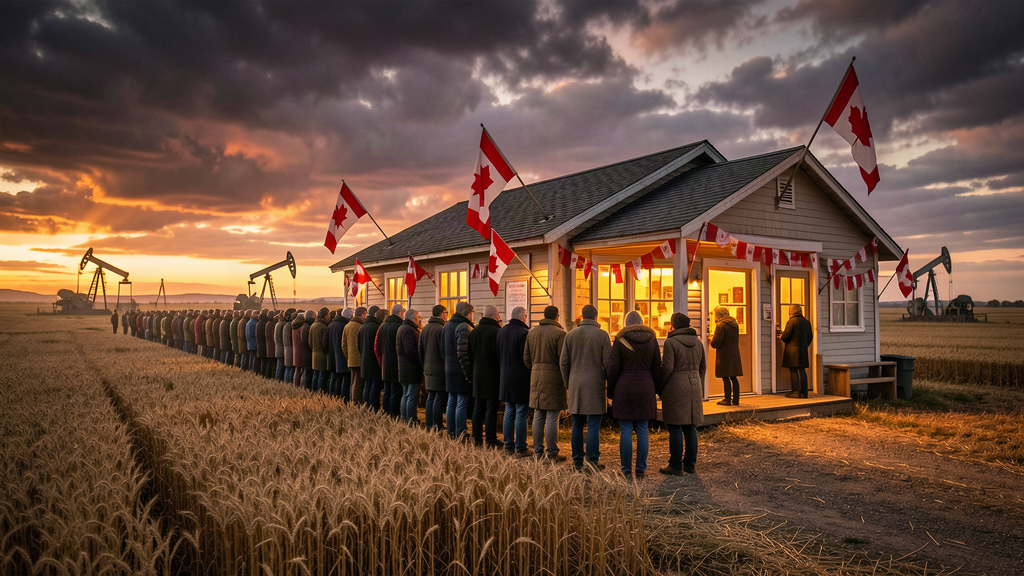
“People call at three in the morning and ask if we are the kind of province that leaves,” Mr. Enns said, and he has answered them patiently, eleven times. “And I say: no, son, we are the kind of province that asks. The leaving part is a later form. This form was ten forms. The separation question was one of them. The other nine were about things like the power to set our own rules, which is a very polite way to say you are angry at Ottawa. We are not leaving. We are filing a grievance in triplicate, and the triplicate is a referendum, and the referendum had an advance poll, and the advance poll had a line, and the line had coffee in it. My mother stood in it for ninety minutes. She said it was the most alive she’d felt since her husband died. The Americans don’t get that. They think a country is a thing you have. A country is a thing you fill out. We chose unity, and unity is on paper, and the paper is in a box, and the box is in a church hall, and the church hall has a percolator. You can’t buy that. You can’t secede from it, either. That’s the joke the whole province voted on, and 174,000 people got up early on a Monday to tell the Americans the joke’s not for them.”
The phone calls have not stopped. A state legislator in Texas announced Monday that his chamber will study “the Alberta model of asking,” with a budget of $40,000 and a chair who has never seen a ballot question. The first hearing is scheduled, in the chair’s words, “when the printers in Edmonton send the sample ballots.”
Quebec attempted the procedure twice, in 1980 and 1995; the first failed about 60-40, the second nearly. Alberta, a province that mostly reads the minutes, set the table better: it put the fire drill on the agenda and then voted, overwhelmingly, to keep the building. The unity Carney thanked the province for was administered, in the end, like a safety inspection: thoroughly, on a weekday, with coffee.
By evening in Ohio, the radio show took the same man’s call again. He wanted it on the record that he had nothing against Canada. He just wanted to know, he said, what happens at the end of all the forms. “They stay,” the host told him. The man considered this. “So the form,” he said, “is a door that says pull.” Alberta has now closed it. The province’s tenth ballot question, the one about the flag, was non-binding, and counted at last, and is being certified this week.