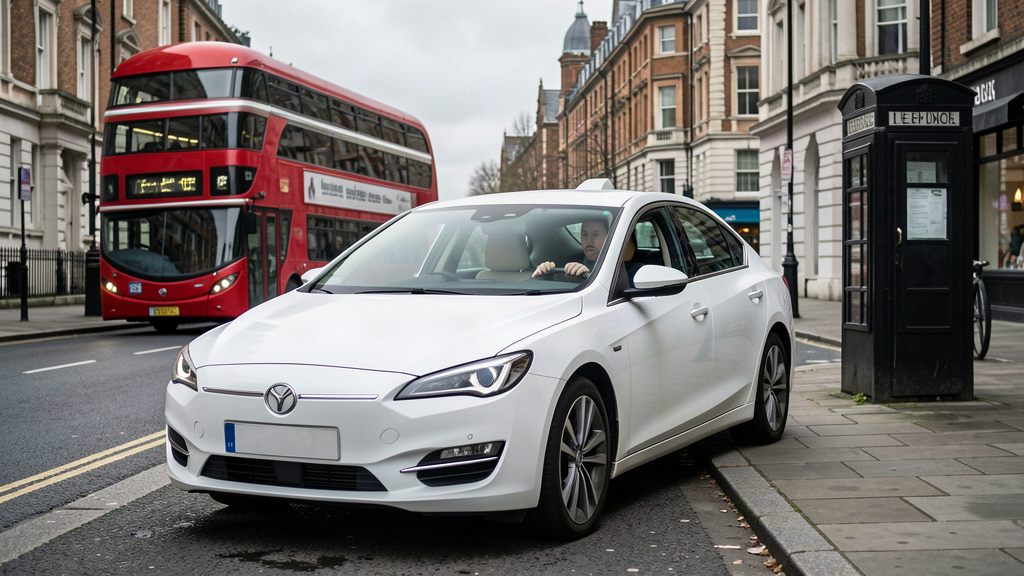
LONDON — The first self-driving taxis have begun operating in London, and the most important fact about them is the one in the driver’s seat. There is a driver in the driver’s seat. The car is driving itself. The person is watching it drive itself. CBS News reports that Uber has fifteen vehicles running in the city, powered by the AI of Wayve, and that a “required supervisor” rides along in each one, which is the phrase the industry uses to mean “the human is still the one who will get blamed.”
The arrangement is, on its face, a contradiction. The car does not need the person. The person is there because the car might need the person, and because the car, in the specific, is new, and new things, in the specific, are the kind of things that are watched. A Wayve co-founder, Alex Kendall, rode along for the demonstration, which is the phrase the company uses to mean “we tested the thing in front of a journalist.” The car did well. The journalist did well. The supervisor in the driver’s seat did the thing the supervisor does, which is not drive, and not quite not drive, and hold the wheel in the exact posture of a person who is one bad turn away from intervening.
Fifteen is a small number, and the small number is the point. This is not a rollout. This is a pilot wearing a rollout’s clothes. The city that has, for a hundred and thirty years, trained its entire population to be suspicious of a person who does not know how to drive, is now being asked to be comfortable in a vehicle that does not know how to drive, but is being supervised by a person who does. The supervisor is the compromise. The supervisor is the whole thing. Remove the supervisor and you have a robot in a coat. Keep the supervisor and you have a person in a car that is mostly a person.
THE FIFTEEN: A TALLY
- How many: Fifteen vehicles, all Uber-branded, all on London streets.
- Who's driving: The car. Technically.
- Who's watching: A "required supervisor," hands near the wheel, in the specific, not touching it.
- The honest math: If the car could drive itself, the supervisor would be a passenger. The supervisor is not a passenger. The supervisor is a passenger who is not allowed to be a passenger. That is the entire business model.
There is a long history, in the history of transportation, of a new technology that is so new it has to be watched. The telephone had an operator. The airplane had a co-pilot. The elevator, for a generation, had a man in a uniform who pressed the button and, in the specific, was the reason the building did not fall. The robotaxi is the newest version of the same idea, which is that a machine that is not quite ready is made ready by the presence of a human who is, in the specific, not doing the thing. The supervisor is not a driver. The supervisor is a witness.
At press time, Uber had not said how long the supervisor would ride along, and Wayve had not said what happens on the day the supervisor finally gets out, and the fifteen cars, for all that is happening to them, were still, in every way that mattered, being watched.