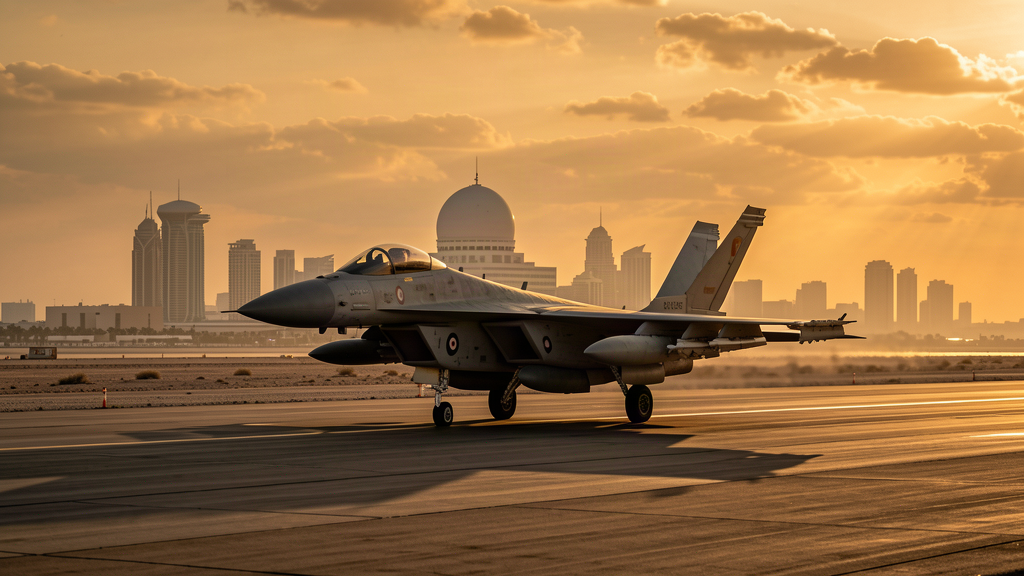
LONDON — Britain announced Tuesday that it will return, once more, to the part of the world it announced, once more, that it was leaving in 1968. The method is characteristically understated: RAF Typhoon fighter jets, a 90-day extension to an aerial refueling contract, and a mission label so grammatically careful that it deserves a literary prize.
The mission is called “defensive counter-air.” As the Ministry of Defence explained in its statement, the aircraft will protect Saudi cities and critical national infrastructure from aerial attack, while operating, in the words of Defense Secretary Wes Streeting, “in a defensive role” and without conducting “offensive strikes.” The distinction, officials assure the public, is meaningful and will be maintained at all times, at high speed, at altitude, by pilots trained extensively in its maintenance.
The move was authorized by Prime Minister Andy Burnham, whose government responded to a month in which Houthi missiles and drones struck deep into Saudi Arabia with a regularity that has made the phrase “critical national infrastructure” feel less like doctrine and more like real estate. A missile strike on Riyadh’s international airport on October 10 killed 13 people and injured more than 300 — the deadliest attack in the kingdom in over a decade. Saudi authorities say 19 people have been killed in attacks on the country’s airports in recent weeks. The Houthis, who seized effective control of the Bab al-Mandab strait this fall, have vowed to continue what their military spokesman calls “escalating operations deep inside Saudi Arabia.”
Britain’s contribution to all of this is jets, tankers, and its finest export: the sentence. “The UK has a responsibility to back allies and protect civilians,” Streeting said — a line that would sound familiar to anyone who has read a British newspaper since roughly 1919. The machinery has changed; the sentence has survived.
A retired air commodore, watching the announcement from a pub in Lincolnshire that has a model Spitfire hanging over the bar, offered the framing that the mission’s critics had somehow overlooked. “We never actually left,” he said. “The lease expired. It’s a very different thing, and I’m glad somebody finally said the quiet part loudly.”
He is right that the pattern will feel familiar to anyone who remembers the previous eleven returns. Britain has protected these skies before, and these skies before those, under governments of both parties, with the same operational caution and the same paperwork. What Washington calls commitment and Brussels calls burden-sharing, Britain calls simply being there — the way one is at a family gathering one does not enjoy.
There is a quieter irony the Americans are too polite to mention. For eighty years the United States ran the security architecture in the Gulf, largely at its own expense, while its European partners purchased the resulting oil at market rates. The Typhoons represent the great correction: Europe is finally paying for its own security, in the same region, over the same oil, with, as it happens, aircraft designed and built jointly with two of America’s closest partners. The burden has not so much shifted as aged gracefully, like the squadron’s mission dates.
The refueling contract now runs another 90 days. Officials stress that the deployment is strictly temporary, defensive, and limited to protecting cities, airports, and energy facilities — which is to say, it covers precisely the things that get attacked, for as long as they keep getting attacked. Britain’s return to the desert is temporary, as all of its returns have been, as all of its departures have been temporary in the other direction.