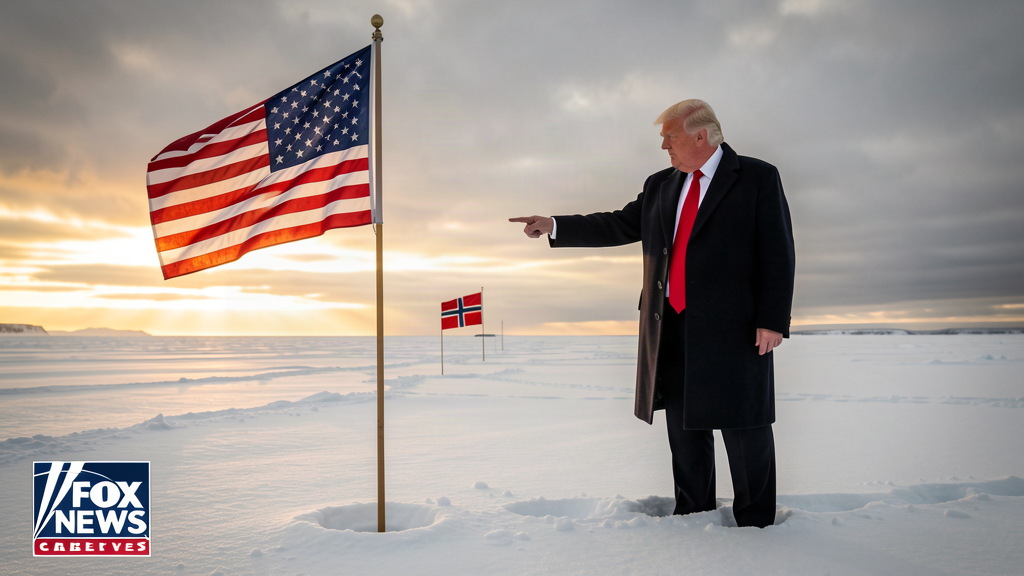
WASHINGTON — President Donald Trump on Friday announced a landmark deal with Denmark that, in his own words, gives the United States “permanent control over security, and all other needs” in Greenland — a sweeping victory that the White House insists is, and I quote, “not the same as owning it,” a distinction the island’s 56,000 residents appear to have accepted with the quiet grace of a people who have had a very long year.
The agreement, which will be signed by all three governments next week, ends months of the President threatening to simply take the island “by force” — a move that had briefly set a NATO ally and a small Arctic population on edge before the two sides found a solution that makes no sense and, somehow, works. As NPR reported, the deal stops short of U.S. control of the island itself while handing Washington a permanent hand on its security.
The genius of the deal, as the President’s own post describes it, is that it “completely address[es] ALL of our many U.S. concerns” while coming “at no cost to Washington.” That phrase — no cost — has become the beating heart of the negotiation, the way a small, hopeful word might in a child who is about to be told he cannot have the cookie but can have the plate.
What the United States is getting, in practical terms, is the security architecture of ownership without the ownership. The agreement will bar Russia and China from establishing bases on the island, per the President’s framing, which is the precise outcome the country has wanted for the entire Arctic decade. What Denmark is getting is the continued sovereignty of its territory, which is also the precise outcome it has wanted. Both sides have therefore obtained exactly what they set out to obtain, which is the rarest of political outcomes and the one most likely to survive a second look.
“That’s not abandonment,” one administration official told reporters, when asked how a deal that stops short of control could be described as control. “That’s a partnership. We control the security. They keep the island. Everybody wins. The math is simple.”
The math is, in fact, simple. The United States gains a strategic foothold in the Arctic. Denmark gains a friend’s promise that its territory will not be annexed. Greenland gains the dignity of having been consulted by three governments about what happens on its land. It is a tripartite win in which the actual residents are the least consulted party, a result that has been described by one local leader as “not a little strange.”
THE GREENLAND DEAL, AT A GLANCE
- U.S. gains: "permanent control over security" in Greenland
- Denmark gains: continued sovereignty over its territory
- Greenland gains: a seat at the table where the table is being moved
- Cost to Washington: none, per the deal's most repeated phrase
- Cost to Denmark: the rest of the phrase
- Russia and China: barred from establishing bases, which is the whole point
The “no cost” framing has drawn particular admiration from the business world, which has long viewed cost as a negotiable concept and the word “permanent” as a kind of marketing. The deal, in other words, is priced at nothing and priced at everything, depending on which side of the signature you happen to be standing on.
Danish Prime Minister Mette Frederiksen, who has spent the past year fielding questions about whether her country was about to lose its largest territory, said the agreement would be “signed by the three governments next week.” The phrasing — three governments, one island — has taken on a ceremonial quality, the way a family might describe three siblings who all, somehow, still live in the same house.
Skeptics have raised the obvious question, which is what “permanent control over security, and all other needs” means in practice. The “and all other needs” clause has not been defined, and the White House has not been willing to define it, and the not-willingness has its own quiet dignity. It is a clause the way a handshake agreement is a clause — present, load-bearing, and enforceable by no one, which is to say: enforceable by everyone.
At press time, construction crews had been dispatched to identify the “appropriate part of Greenland” where the large military presence would go, a task that is technically a survey and spiritually a referendum. The flag on the island had not yet been changed. It would not be, the deal implies. And yet, somewhere in the Arctic wind, the American flag now flies a little taller than it used to.