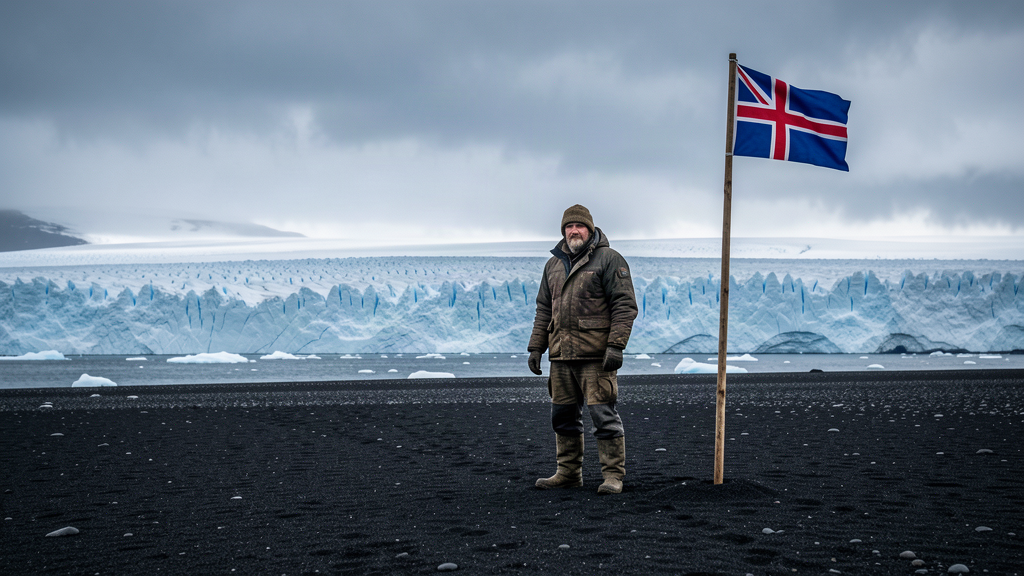
REYKJAVIK — Iceland has voted “No” to the European Union, and the result, by the standards of continental politics, is so modest that it has temporarily made the rest of the continent look like a soap opera. In a referendum held under what officials have described, with a calm that borders on the geological, as “the shadow of the Greenland question,” 52.8% of Icelanders rejected the government’s proposal to reopen talks with Brussels, against 47.2% in favor. Eighty-two and a half percent of eligible voters showed up, which, in a country of roughly 380,000 people, is the entire country, plus the post office.
The margin was narrow enough to keep the “Yes” camp in a state of what one supporter called “respectful disappointment,” and wide enough, per the government, to constitute “a significant decision now lying ahead for the Icelandic people,” a phrase that, in Icelandic, has the same weight as “the glacier is, at this time, a glacier.”
The timing has not been lost on observers. The referendum came as the United States renewed its long-held, and occasionally less long-held, interest in Greenland, the world’s largest island, which sits, geographically, between Iceland’s independence and Iceland’s comfort zone. Iceland, which is not Greenland, has nonetheless spent the past several months operating on the assumption that the two are, in some relevant sense, neighbors, and that a question about one is, in some relevant sense, a question about the other.
The practical effect of the “No” is that Iceland will remain, as it has been for decades, a country that is not in the Schengen Area the way it is in the Schengen Area, that is a member of the European Economic Area, and that exports, at this writing, a large number of fish to a continent it is, per the vote, no longer planning to join. The fishing industry has responded with the kind of relief that is, in the industry, treated as a natural resource.
THE VOTE, AT A GLANCE
- 52.8% “No,” 47.2% “Yes,” a margin that, in Reykjavik, is considered “a difference of opinion” rather than a result
- 82.5% turnout, the full population, plus, per the election office, “a few tourists who were, at the time, inside the polling station”
- The European Economic Area, which Iceland is in, is not, per the government, “the same thing,” in the way that a parking garage is not “the same thing” as the car parked inside it
- Greenland, which is not Iceland, remains, per the United States, “a topic,” and, per Iceland, “not our topic”
- The fishing quota, which is the actual economy, was, per the vote, “safeguarded,” a word the industry has added to its logo
The European Union, for its part, issued a statement describing the result as “respectful” and “understood,” which is, in the union’s diplomatic vocabulary, the phrase it uses when it has, in fact, lost, and is, at this time, choosing to say so in the gentlest available register.
At press time, the glacier, which has been present for roughly 2.2 million years and which was not, at any point, asked to take a position, was, per all available accounts, still a glacier.