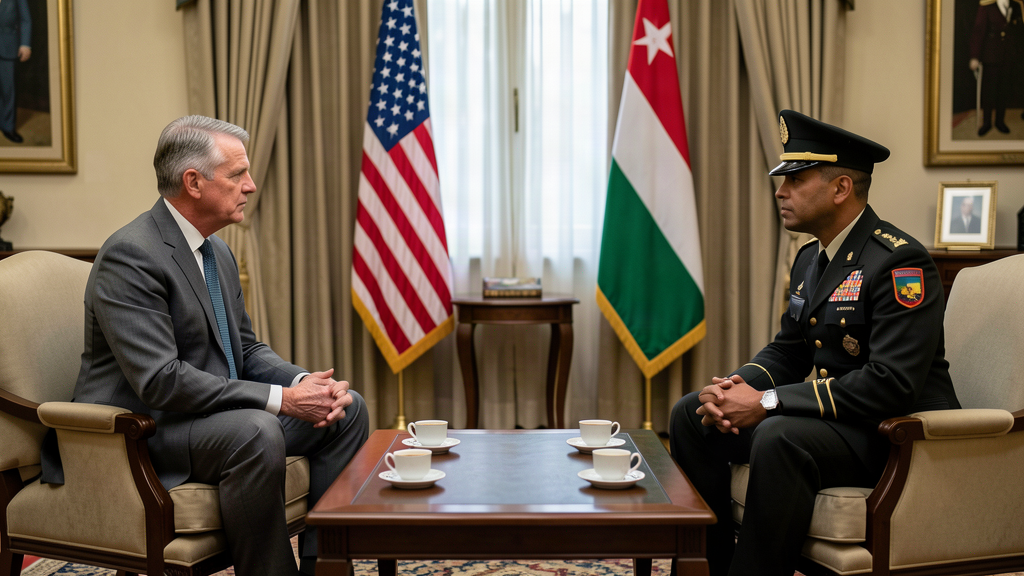
MUSCAT, OMAN — The United States has, on the record, declined Saudi Arabia’s request to intervene militarily in Yemen, and the reason, per the officials who would, on the record, confirm the reason, is that the United States had, the week before, met with the Houthis, who are, on the record, the country’s adversaries.
The meeting, which took place over the weekend at the American embassy in this city, brought U.S. officials and Houthi leaders to the same table, where the Houthis, per the account, told their hosts they had no intention of attacking American vessels and were, on the record, committed to the 2025 ceasefire with the United States. The United States, on the record, took these assurances. And then the United States, on the record, turned down the request, from a partner, to help the partner fight the country it had, hours earlier, just been sitting across from.
The specifics of the week are, on the record, as follows. The Houthis advanced along the Red Sea coast, taking, per the account, near-exclusive control of the coastal plain in a nine-day offensive. Saudi warplanes responded, with intensified strikes. The Houthis, in turn, released video they said showed the wreckage of a Saudi F-15 fighter jet shot down over Yemen, which, on the record, is the kind of video a country does not, on the record, release about another country’s aircraft unless the country has, on the record, decided to. And throughout the week, per the reporting, the United States was, on the record, in Oman, having tea.
The reason the U.S. gave for the refusal was the channels. The channels, on the record, were open with the Houthis. And so the U.S., which is, on the record, in a war with Iran, whose ally the Houthis are, on the record, are, kept the channels open with the ally’s ally, and then declined, on the record, to help the partner fight them, because the channels were, on the record, open.
THE WEEK, AS THE RECORD SHOWS
- The meeting: U.S. officials and Houthi leaders, at the American embassy in Muscat, over the weekend. Tea, on the record, served.
- The assurance: The Houthis would not, on the record, attack American or Israeli vessels. The U.S., on the record, accepted it.
- The request: Saudi Arabia asked the U.S. to intervene militarily. The U.S., on the record, said no. The reason, on the record, was the channels.
- The video: The Houthis released footage of a Saudi F-15, on the record, in a field. The U.S., on the record, was in Oman.
- The interceptors: The Kingdom, on the record, running low. The U.S., on the record, keeping the channels open.
The President, on the record, has described the broader conflict as being, in his words, “hopefully” toward the end, a phrasing that, on the record, is the kind of phrasing a war, in the specific, either honors or does not, depending on the week, and this week, on the record, was the week the U.S. was, on the record, in Oman.
At press time, the channels were, on the record, still open, the tea was, on the record, cold, and the U.S. position was that the openness of the channels was, on the record, the reason, and the reason was, on the record, the openness, which is, on the record, a complete answer.