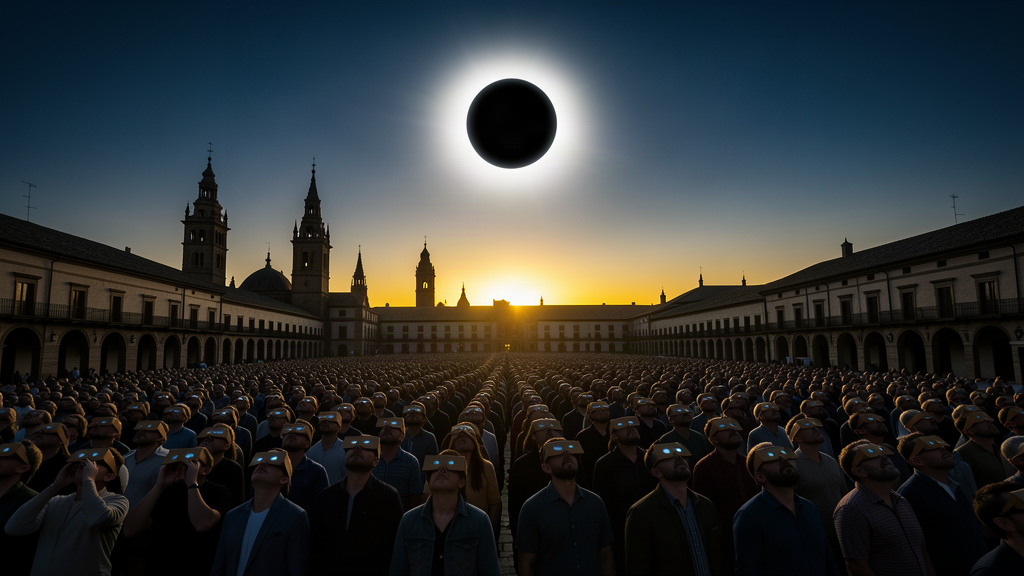
MADRID — Spain has thrown some magnificent spectacles over the years: bullfights, football matches, the running of the bulls, and that one time the entire country collectively decided to stay up until 4 a.m. for no particular reason. On Wednesday, the moon topped them all. Millions of people crowded cloudless Spanish cities for the country’s first total solar eclipse in more than a century, and when the sky went dark, they did what any sensible audience does: they applauded.
“As the sky darkened, gradually at first and then quickly, people broke into applause and cheered,” one observer reported from the hills outside Valladolid, where crowds had gathered at a park called Cerro de Contienda. The last time Spain saw a total eclipse was 1905 — before the country had airports, highways, or a tourism campaign — so the moon had a lot of build-up to live up to. It delivered. The sun went black, the corona blazed, the birds stopped singing, and for four minutes and change, the entire country stood in the dark, looking up, completely silent except for the cheering.
The performance was not without its logistical hiccups. In the days before the eclipse, Spanish consumer authorities recalled model after model of eclipse glasses — six, then a seventh, withdrawn over the risk of serious eye damage — pulling nearly 100 pairs of unsafe eyewear off the market. In other words, the country spent a century preparing for four minutes of darkness, and its biggest challenge was the glasses. Officials urged anyone who had bought recalled models to return them immediately and, presumably, to watch the greatest show in the sky through a colander, as nature intended.
Local businesses leaned into the moment. In Valladolid, cafés sold “eclipse menus” — dark bread, black olives, squid ink paella — while supermarkets reportedly sold out of colanders within hours. One baker in Zamora was said to have produced a loaf of bread shaped like the moon, which was, fittingly, completely inedible.
“This is the proudest day for Spanish astronomy since 1905, and possibly the proudest day for Spanish colander sales in recorded history,” said Margarita Fuentes, a self-described “professional eclipse watcher” who had traveled from Barcelona with a suitcase containing 14 pairs of glasses, six of which were later recalled.
The eclipse also crossed parts of Greenland and Iceland, where the crowds were smaller, the darkness was longer, and the applause was reportedly more reserved, in keeping with local custom.
TOTALITY BY THE NUMBERS: OFFICIAL ECLIPSE STATISTICS
- Years since Spain's last total solar eclipse: 121 (the moon is a patient performer)
- Approximate minutes of total darkness: 4 (a full act, by celestial standards)
- Models of eclipse glasses recalled by Spanish authorities: 7 (a world record for eyewear drama)
- Pairs of unsafe glasses pulled from the market: nearly 100 (all of them now collectors' items)
- Audience reaction: standing ovation, plus several thousand phone videos of a dark sky
- Colanders sold in Valladolid in the final 48 hours: estimated 40,000 (unofficial)
At press time, the moon had reportedly received multiple offers to headline future Spanish events, including a request from the tourism ministry to return in 2037 “but with better merchandise.”