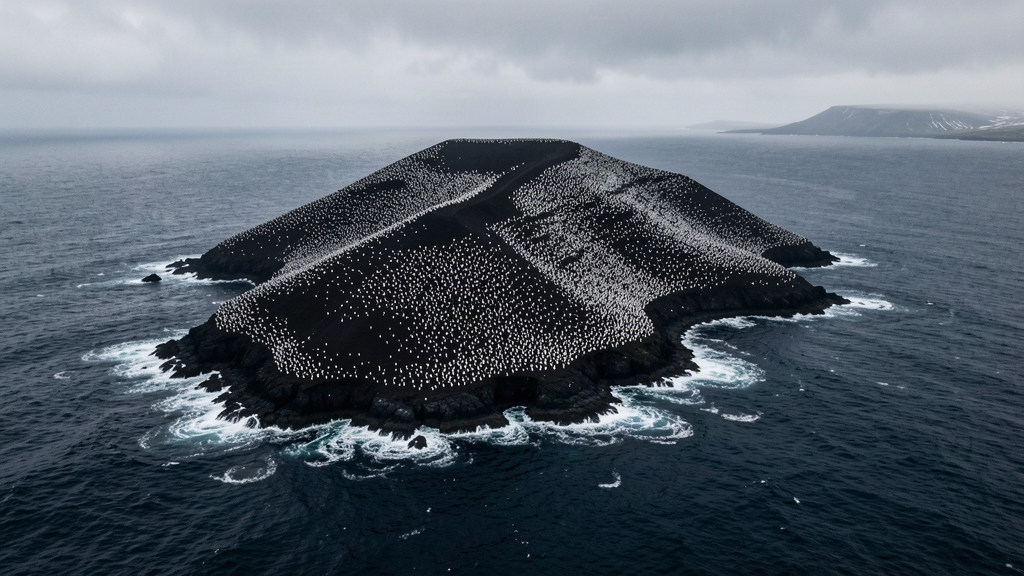
ZAVODOVSKI ISLAND, Antarctica — For as long as anyone had been counting, the largest penguin colony on Earth lived on a rock nobody visits. This week, by the quiet arithmetic of an aerial survey, it stopped being the largest.
The island is Zavodovski: a volcanic cone near the South Sandwich Islands, home to more chinstrap penguins than any place on the planet — so many that this single colony represented roughly 30 percent of the entire global chinstrap population. Researchers from the British Antarctic Survey flew over it this year and counted what was left. The colony has declined by two-thirds since 2011, a loss of more than 250,000 breeding pairs, and the title of Largest Colony on Earth has passed, unceremoniously, to a colony in the Ross Sea.
The mechanism, as the scientists tell it, is a story of a restaurant that moved.
Chinstraps eat krill. Krill like cold water. As the waters around the island have warmed, the krill have moved south, into the Weddell Sea. The penguins, who are loyal to their nesting island the way a man is loyal to his hometown, would like to follow. They cannot. The sea ice to the south is unfriendly, and there are no suitable islands in between on which to rest, refuel, and raise a family. The food has moved. The real estate has not.
So the penguins stand on the best island in the world, in the exact spot their species has used for generations, and watch the buffet relocate.
ZAVODOVSKI: BY THE NUMBERS
- Peak: the largest penguin colony on Earth, visible from space
- Decline: two-thirds of the colony since 2011
- Loss: more than 250,000 breeding pairs
- Global share: this one island held about 30% of all chinstrap penguins
- Current rank: second
There is a temptation, on an island this remote, to call the story small. Nothing here has a border, a capital, or a stock exchange. No one has ever sold a thing on Zavodovski. And yet the colony that fed the world’s imagination of penguins — the one that made the animal a symbol of endurance, of huddling, of making it through the cold together — has spent fifteen years quietly thinning out, and the news arrived this week in the form of a title change, as if a crown had been passed at a ceremony no one attended.
The researchers’ tone is careful, which is how researchers say they are frightened. “It’s really concerning,” one of them, who was not involved in the study, told National Geographic, in the understated way of a man watching a third of a species’ real estate go dark.
The island remains beautiful. The krill remain south. The distance between them is the whole story.