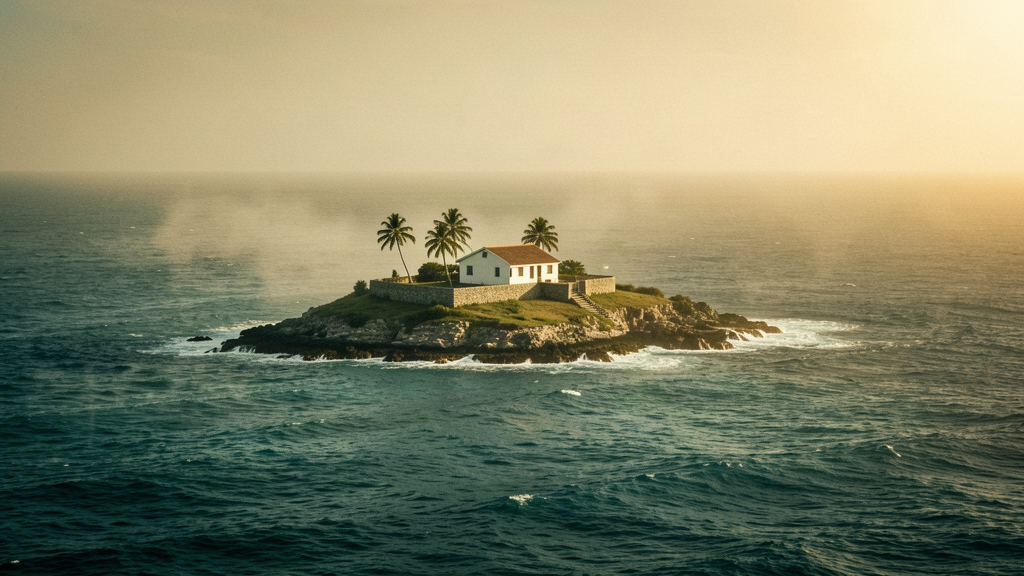
CASTRIES, SAINT LUCIA — For the better part of a decade, there was a number. Everyone knew the number. It was 1.5 degrees Celsius, and it was the line. Not a guideline, not a target with the soft edges of a New Year’s resolution, but the line. The line we were told, in the most formal and international of settings, that if we crossed, the worst would start. The line that, for the small island nations of the Caribbean, the Pacific, and the Indian Ocean, was not an abstraction. It was the difference between a reef that recovers and one that does not, between a well that stays fresh and one that turns to salt.
A new United Nations Environment Programme report, Limiting Overshoot, has now updated the number’s status. It is no longer a line we are trying to avoid crossing. It is a line we are now expected to cross. The question is no longer if. The report’s own words frame the new set of questions: how high will the overshoot go, how long will it last, and how do we live through it while we work to bring the temperature back down.
Dr. Shobha Maharaj, a Caribbean scientist and a lead author of the report, has spent her career defending that number. Asked what has changed, she was direct.
The report is careful, and it should be, because the stakes are not a headline. The consequences, it notes, will not begin with an island vanishing beneath the sea in a single dramatic night. They will begin more quietly. Saltwater will creep into the freshwater that fills a kitchen garden that has fed a family for generations. High tides will reach the road on a clear day, a day with no storm, no explanation, just the sea being where it is. When a reef dies, a community loses not only the fish and the tourists but the natural barrier that used to break the wave before it reached the shore.
None of this, Dr. Maharaj points out, requires an island to disappear first.
THE REPORT, IN THE REPORT'S OWN CAUTION
- The world is now expected to cross 1.5 degrees above pre-industrial levels.
- Sea-level rise will continue for centuries, even if temperatures fall back down.
- Some losses — reefs, biodiversity, glaciers — would persist. A return to 1.5 would not restore what was there before.
- "Adaptation buys time, not immunity."
- "There is no higher ground to move to, no deep treasury to draw on, and no second reef when one of them dies."
That last one is the sentence the rest of the report is built to explain. In a wealthy, temperate country, an extra half-degree of warming is a serious cost. On a small island, the report argues, it is a binary. There is no second reef. There is no higher ground that is not already someone else’s roof.
The report is also, to its credit, honest about the money. Climate finance, Dr. Maharaj says, arrives too slowly and often arrives as a loan, which is to say it arrives as a new bill for a problem you did not cause. A disaster drains the public funds into emergency response and reconstruction, which leaves less money to reduce the risk of the next one, which then hits a weaker country harder. The report calls this a wheel. It does not say it is the only wheel. It simply declines to pretend it is.
There is a word the report uses, and it is worth repeating because it is a word that does not come up often in a document of this kind. It is “failure.” Crossing 1.5, Dr. Maharaj says, “represents a profound failure of collective will.” And then, in the next breath, it is not permission to give up, because how high the peak rises, and how quickly it comes back down, “are all still ours to decide.”
That is the whole story in two sentences, and it is a strange one to be reading on a Tuesday. We did not win the argument about the number. We are now reading the instructions for the version of the world that the number was supposed to prevent. The small island nations that spent a decade being the loudest voice in the room about what 1.5 meant have, in a sense, been right all along. They just were right about a thing that, until this week, everyone else was still pretending was in the future.
At press time, Dr. Maharaj said she was “helping to write the science of what lies beyond that line,” and that doing so, both personally and professionally, “is a heavy thing.” The report does not offer a sixth game to play. It offers a number, a warning, and a window that is “not a large one.” The window is open. What goes through it, the report suggests, is still being decided.