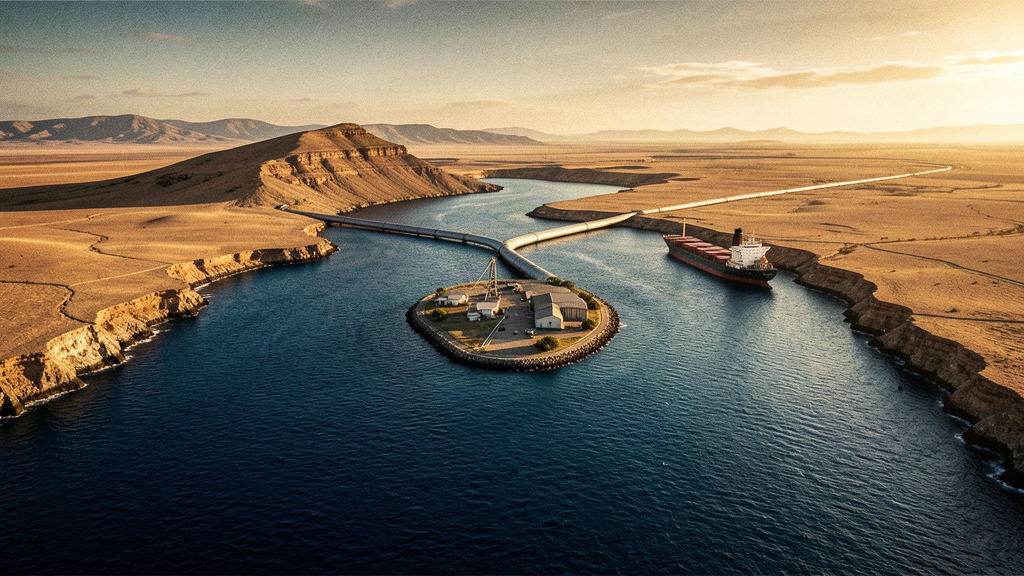
CAIRO — Iran-backed Houthi rebels on Thursday captured the Yemeni port of Mokha and the island of Zuqar, completing what one regional analyst called “the most efficient seizure of the world’s most important shipping lane in a generation,” while Saudi Arabia announced it had stood down its air force — a decision it later attributed, with notable precision, to the fact that it had not yet received a green light from the United States.
The move puts the Bab el-Mandeb strait, the narrow choke point that links the Gulf of Aden to the Red Sea and carries a large share of the oil and container traffic between Europe and Asia, under Houthi control. Ships that had been transiting the lane have, in the words of a shipping source, “started asking for permission.”
Saudi Arabia, for its part, shut down its East-West oil pipeline “as a precaution” a day after it was attacked by drones — an attack that, by at least one account, was launched from Iraq — and said, separately, that its air force did not move against the advancing Houthis because it was, effectively, waiting on a call.
A senior military official with Yemen’s internationally recognized government told the press they were “stunned that the Saudi air force did not try to prevent the capture of Mokha,” and assessed, in a sentence that has since become the defining quote of the week, that “Saudi Arabia didn’t get a green light from the U.S.”
The reframe, once it began, was remarkably fast. This is not, by this account, a case of a $1 trillion economy unable to defend its coast. It is a case of “respectful coordination,” of “the world’s most disciplined alliance doing exactly what the world’s most disciplined alliance does.”
“A trillion-dollar economy, and it still checks first. That’s not weakness. That’s process,” a regional security advisor said, without elaboration. “You don’t strike a coast without a green light. That’s not a failure of force. That’s a success of the alliance.”
The Houthi side, which has spent the past two years denying it would charge ships for transiting the Red Sea, is not, by most accounts, commenting on the pipeline. It is, however, commenting on the island.
THE NEW RED SEA ORDER, AS OF FRIDAY
- Port of Mokha, roughly 50 miles from the strait: seized by the Houthis, Thursday.
- Island of Zuqar, at the strait's southern entrance: seized by the Houthis, Thursday.
- Bab el-Mandeb strait: now, by most accounts, under Houthi control.
- Saudi East-West oil pipeline: shut down "as a precaution" following a drone attack.
- Saudi air force: on standby, awaiting, per the regional official, a U.S. green light.
- Oil prices: up, but, per a London trader, "respectfully up."
The strategic arithmetic, as it is being explained to the public, is that a strait held by rebels is a strait that can be negotiated, which is, by the theory, better than a strait that is merely open, because an open strait is a strait you have to defend, while a held strait is a strait you have to talk to.
At press time, the U.S. State Department had not confirmed whether the green light was, in fact, in review, but a shipping insurer in Rotterdam said it was “already re-pricing every contract that crosses the strait,” and a Yemeni fishing boat operating near Mokha had, by all reports, simply kept fishing.
“We don’t follow the borders,” the captain said. “We follow the fish.”