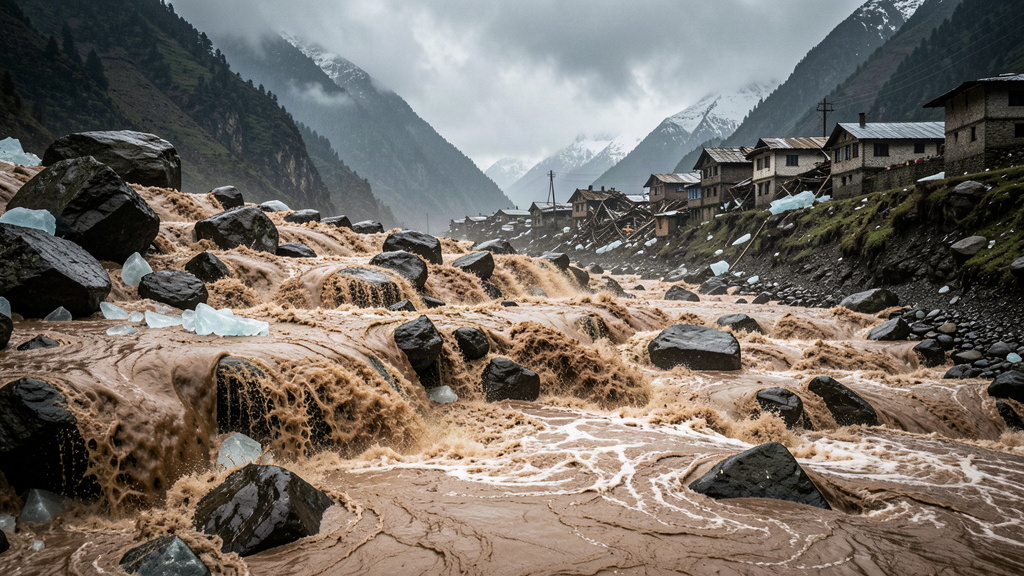
KATHMANDU — A glacier, which had been sitting quietly on the border between Nepal and Tibet for several thousand years, decided, on the morning of August 26, to leave. What followed was a landslide of ice and rock that sent a wall of water, mud, and boulders down the Trishuli River, destroyed the Gyirong border checkpoint, and killed, by the count that has so far survived contact with the water, more than a thousand people, with several thousand more unaccounted for.
The United States Geological Survey has attributed the event to a glacial collapse, which is the way scientists describe what happens when a piece of the Earth that has been, for a very long time, in one place, decides that it would prefer to be in another. The river in question, the Trishuli, is also known as the Bhotekoshi, and it runs along the border between Rasuwa district in Nepal and Gyirong County in Tibet, a stretch of water that is now, in the main, a memory.
The scale of the damage is difficult to render in the units the news is used to. A 72-kilometer stretch of the river valley was struck. The border checkpoint, which is the kind of place that exists for the specific purpose of telling people where one country ends and another begins, was destroyed, which is, in the abstract, a statement about the border. Several power stations under construction were damaged, which is, in the abstract, a statement about the future. The water did not, in any of these cases, ask permission.
The part of the story that the coverage tends to put in the second paragraph, and that belongs in the first, is that this was expected. The Himalaya is, by any measure, the most climate-sensitive place on Earth, and the glaciers that hold back the water of the region have been, for decades, the subject of a body of research that has, in the aggregate, said the same thing in the same order: they are getting warmer, they are getting smaller, and the water they have been holding is going to go somewhere. The somewhere, in this case, turned out to be the Trishuli, and then, subsequently, the places where people live next to the Trishuli.
There is a word for what happens when a prediction is right, and the word is “confirmation,” and it is a word that the research community has been using, for years, with a kind of tired precision, the way a doctor uses the word “as expected.” The research was not wrong. The research was, in the specific, not early enough. This is the difference between a forecast and a warning, and it is a difference that a thousand people, in the specific, will not live long enough to find out.
THE FLOOD, AT A GLANCE (August 26, 2026)
- Cause: Glacial collapse + landslide, per the USGS
- River: Trishuli / Bhotekoshi, on the Nepal–Tibet border
- Stretched: ~72 km of valley struck
- Dead: 1,000+ confirmed
- Missing: several thousand, still unaccounted for
- Also destroyed: the Gyirong border checkpoint
The rescue effort is, in the words of the people doing it, ongoing, which is the phrase that means the work has not stopped and the number has not finished moving. Rescuers are still searching for the missing, in a valley where the water has, in the specific, rearranged the geography, and the definition of “where the village was” is now a question the water has, in the specific, answered.
At press time, Nepali officials confirmed that the death toll was “expected to rise,” which is the way a government tells the public that the number is not finished, and that the number will not be finished in a way that comforts anyone, and that the water, in the specific, is still where the water is.