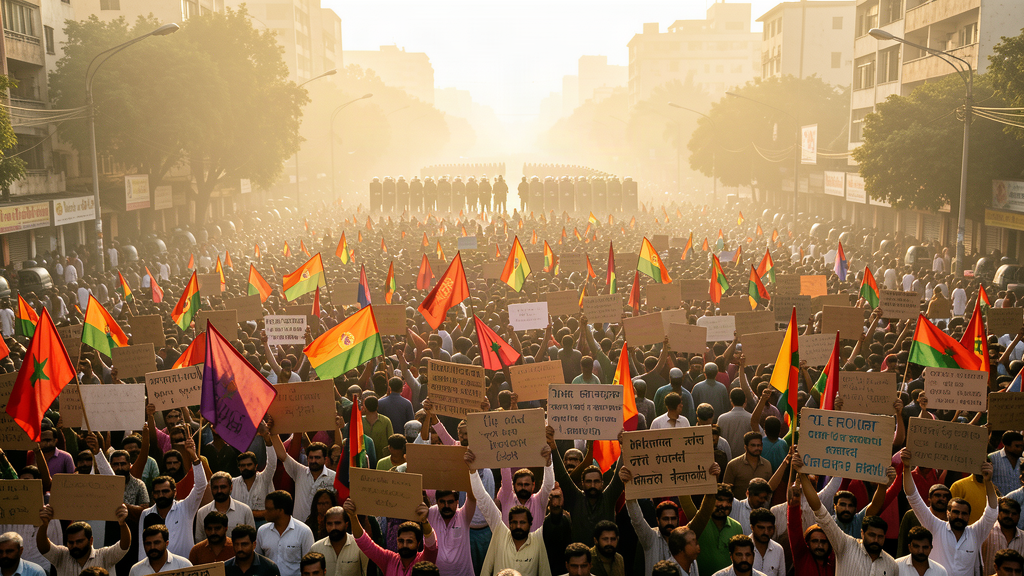
NEW DELHI — India’s opposition has discovered the secret to winning arguments: lose them to the police, then frame the paperwork.
After Delhi Police registered a criminal complaint — an FIR, the founding document of Indian law enforcement — against Leader of the Opposition Rahul Gandhi and his sister Priyanka Gandhi Vadra over an alleged “forcible entry” into the Akashvani Bhavan government complex during a protest, the opposition’s response was not shame. It was framing. “Every FIR is a medal,” Gandhi told supporters, and the crowd, being Indian, immediately began pricing the merchandise.
The complaint stems from Tuesday’s INDIA bloc march demanding the resignation of the chief election commissioner over irregularities in the revision of the voter rolls — a dispute so procedural that it has captivated the world’s largest democracy the way a disputed foul captivates a stadium. The opposition says the roll revision is purging poor and minority voters. The government says the revision is exactly what roll revisions are for. Both sides agree the other side should be calmer about it.
What makes the episode instructive for students of democracy everywhere is the alchemy. In most countries, a police complaint against the Leader of the Opposition is a scandal. In India it is a receipt — proof that the protest was large enough to require a form. Gandhi and his sister were detained, released, and charged in the single most efficient news cycle available: the same afternoon.
The government’s position, articulated by officials speaking with the patience of people who own the police, is that forcible entry is forcible regardless of how many people do it while singing. The opposition’s position is that the Akashvani Bhavan — the home of India’s state broadcaster — was opened to them by “the people,” a category of visitor that no door policy has ever successfully restricted.
THE FIR, EXPLAINED FOR AMERICANS
- What it is: First Information Report — the document that starts a criminal case in India.
- Who got one: The Leader of the Opposition, a former congress president, and "several others," a phrase that in India includes everyone within shouting distance.
- The charge: Forcible entry into a government building, allegedly committed by a crowd, which is the only kind of crowd that can commit forcible entry at scale.
- The opposition's response: A march to Jantar Mantar, Delhi's official protest corner, where the government has historically tolerated everything except being thanked for it.
- Medal value: Rising. Street vendors reported FIR-themed keychains sold out before the complaint was even numbered.
Analysts note the maneuver is not new — Indian politics has a long tradition of converting state friction into campaign fuel — but the speed is unprecedented. The complaint was filed Tuesday. By Wednesday morning the slogan was printed on shirts. By Wednesday afternoon the shirts were the story.
At press time, the Delhi Police announced they were investigating who printed the shirts, and the opposition announced it would like that FIR as well, framed, size large.