STOCKHOLM — Sweden is holding its general election on Sunday, and by every measurable standard it is the closest national contest in the country’s modern history, which the two blocs have both, independently, described as “very reassuring.”
The latest poll, from Dagens Nyheter and Ipsos, puts the gap between the four-party left led by Magdalena Andersson and the ruling right led by Prime Minister Ulf Kristersson at a single decimal point: 0.3 percent — 175 seats to 174, a margin so thin that the country’s statistical office has, by one account, requested a second set of calculators.
What makes the number remarkable is not how small it is. It is how much both sides have insisted on it.
“If you’re winning by a single decimal point,” one right-wing campaign manager told a local outlet, “then you’re winning by a lot, because the decimal is on your side of the zero.” His counterpart on the left, asked about the same figure, described a race decided by 175 to 174 as “effectively a tie in which we are ahead,” a phrasing that the Swedish language, which does not have a word for it, is reportedly still working to accommodate.
The race is, by the by, the first in which the far-right Sweden Democrats stand a realistic chance of entering a government at all. Polling gives the party a seat at the table — and, per Al Jazeera’s read of the coalition math, the ruling bloc has signaled it will bring them in to secure a second term for Kristersson, a move that, in the party’s own framing, “can expect Cabinet posts in the next government,” a line the opposition has, for its part, described as “a first in a way that we are both, independently, calling ‘historic.’”
The campaign, to its credit, has been unusually even-handed, which the media have noted with a mixture of admiration and concern. Both blocs have run ads that, by any account, look like they came from the same creative agency, which is, according to at least one political scientist, “the closest a democratic election has come to a split decision rendered by both defendants.”
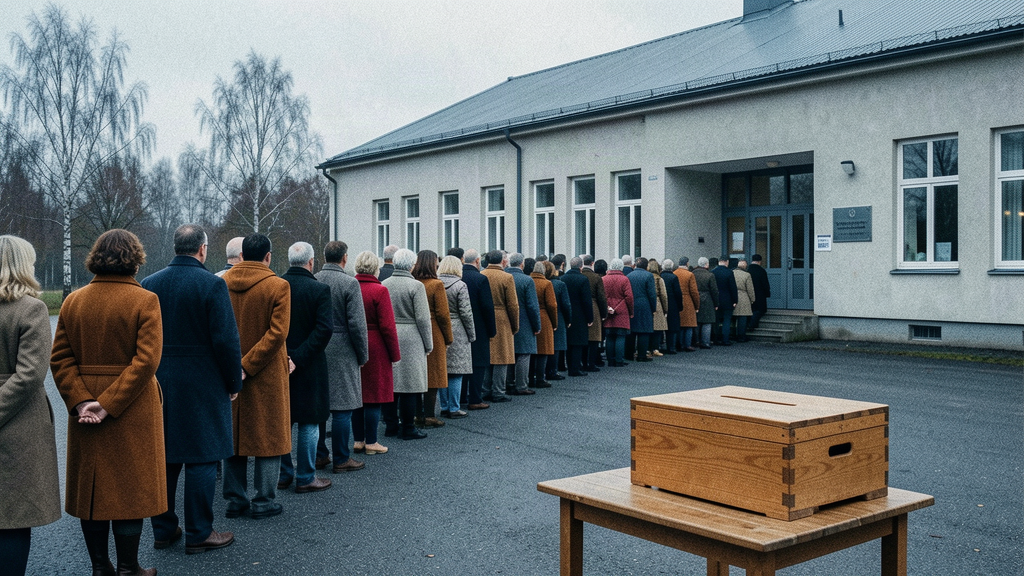
A voter in the city of Malmö, waiting in line outside her polling station on a morning that was, by all reports, “very Swedish,” offered the day’s most quoted observation.
“I don’t know who I’m voting for,” she said. “I know who I’m voting against, and that’s also a decimal point, so it’s the same thing. We’re all just decimal points now.”
THE ELECTION, IN NUMBERS
- Polls: left bloc 175, right bloc 174 — a 0.3-point gap.
- Parties in each bloc: four.
- Far-right Sweden Democrats projected share: a double-digit slice of the vote, per pre-election polling.
- First-ever chance for the far right to govern: yes, if the right bloc wins.
- Margin of error on the deciding poll: larger than the gap.
- What both sides call the result of a 0.3-point lead: "a strong mandate."
At press time, the polls had not yet closed, and the counting was expected to take until early Monday morning, at which point the leading bloc’s spokesperson was scheduled to describe the outcome as “a victory so close it is, statistically speaking, a tie,” while the trailing bloc’s spokesperson was scheduled to describe the identical outcome as “a loss so narrow it is, statistically speaking, a tie,” and both were expected to, within the hour, announce the establishment of a commission to determine what a 0.3-point gap is, “for the historical record.”