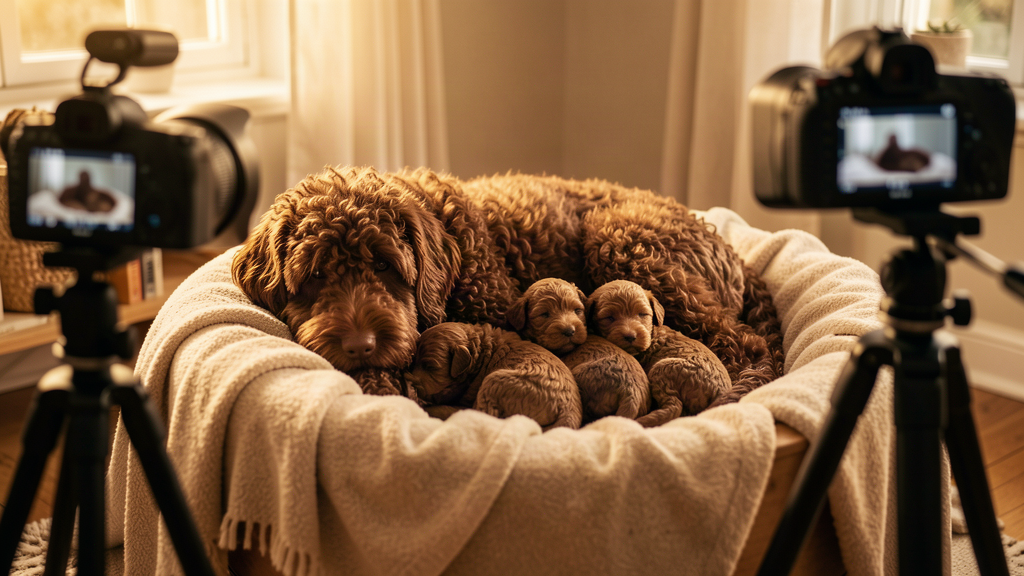
HELSINKI — At 2:14 on Wednesday morning, one of six newborn puppies in a whelping box in southern Finland rolled over. Approximately 1.2 million people checked on it.
By midday, the roll had been discussed on commuter trains, in parliamentary corridors, and at one factory shift change, where a foreman was overheard telling a line worker that the smallest puppy “is finding his legs.” By evening, Yle, Finland’s public broadcaster, announced that its 24/7 puppy stream, Pentulive — the name translates, without apology, to Puppy Live — was on pace to break its own viewing records for a sixth season.
The cast is small. There is Hilkka, a four-year-old Lagotto Romagnolo, a curly Italian breed historically used for finding truffles, which means the mother of this production has a job title and the rest of the country does not. There are six puppies, who spend up to twenty hours a day asleep, which is most of the day, and all of the broadcast.
The day moves in acts. Overnight: breathing, twitching, the occasional full-body wobble that wakes a puppy where it stands. Morning: nursing, followed by a pile of dogs approximately one puppy deep. Afternoon: the same pile, rearranged, which viewers describe as a development arc. Evening: a live chat session with the breeder, who answers questions with the patience of a man who has been asked, four seasons running, whether puppy number three has a girlfriend. He has never been told what to say, and he has never needed it.
Visitors from the television industry ask about the cameras. There are several. They ask about the crew. There is a crew, including a night shift, which reviews footage of sleeping dogs at three in the morning and flags anything unusual, meaning: a yawn of unusual ambition.
The format has a pedigree. Slow television began in Norway in 2009 with seven hours of a train ride, and the neighbors have been unbothered by escalation ever since; Sweden, meanwhile, still runs a celebrated live feed of migrating moose. But the puppies have something the train and the moose never managed. They are small, and they are new, and the audience is being allowed to watch the whole thing — the first steps, the first solid food, the adoptions in spring — which has produced the single most devoted following in Nordic television and a national argument about whether the finale will make it to a theatrical release.
A visiting American network executive, touring Yle’s facilities this week, reportedly stopped in front of the monitor wall for eleven minutes. He asked how much the programming costs. He was given the number. He asked what the return was. He was told: the puppies grow, and the nation watches them grow. The executive was later seen watching a replay of a puppy falling over. He did not appear embarrassed.
At 1:58 a.m. local time Thursday, the smallest puppy stood up, took three steps away from its mother, sat down, and went back to sleep. Somewhere in Oulu, an office worker cried. The stream did not cut. It never cuts.