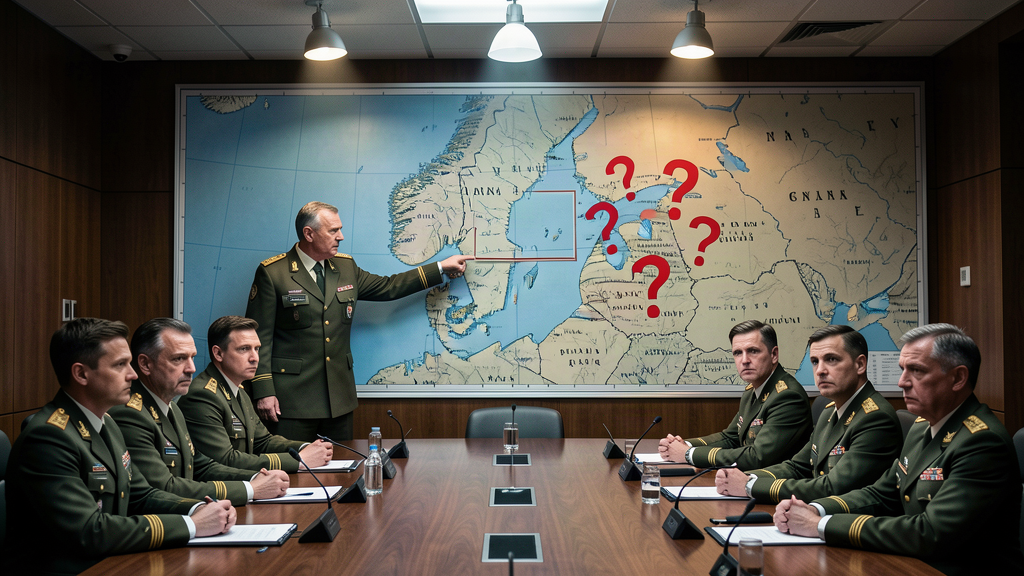
VILNIUS, LITHUANIA — NATO’s eastern flank is bracing for an attack that, according to the alliance’s most senior officials, could come at any time, in any place, from any direction — and whose true author has already been identified, preemptively, as someone who will deny it.
Lithuania’s defence minister, Robertas Kaunas, warned this week that Russia could be considering “false flag” provocations against NATO countries in the Baltic region. President Gitanas Nausėda elaborated that intelligence points to “limited kinetic operations” targeting critical infrastructure — though, as he candidly noted, the intelligence did not identify a specific location or timing.
Which is, as every serious student of modern warfare understands, exactly the right amount of information. Knowing the hour of an attack is a luxury. Knowing the place is a courtesy. Knowing that an attack is coming, somewhere, eventually, by someone who will blame someone else — that is the kind of situational awareness that wins wars, or at least briefings.
The “false flag” concept is one of the great gifts of modern statecraft: an operation designed to look like it was carried out by somebody else. The attacker gets plausible deniability; the victim gets a mystery; the intelligence community gets job security. Everyone wins, except, presumably, whoever gets hit.
Poland has gone even further, with Defence Minister Władysław Kosiniak-Kamysz warning that Russia may use captured Ukrainian drones to stage provocations against NATO territory — a plan that requires the attackers to borrow the equipment, the victim’s allies to recognize the equipment, and everyone to pretend not to notice whose inventory it came from. It is, in short, a masterwork of international theater.
Russia, for its part, has dismissed the warnings as an excuse to justify NATO’s military buildup in the Baltics — a denial that, under the false-flag doctrine, is itself considered corroborating evidence. If Russia says it didn’t do it, the logic runs, it probably did. And if Russia says it did do it, it’s definitely a false flag. The system is airtight.
FALSE FLAG OPERATIONS: A FIELD GUIDE
- Step 1: Carry out an attack while dressed as the enemy, using the enemy's captured equipment, ideally at a border the enemy has never crossed.
- Step 2: Deny involvement with the phrase "we have no idea what you're talking about," which intelligence analysts universally describe as "telling."
- Step 3: Point out that the attack was too clumsy to be yours, which is exactly what you would say if it were yours.
- Step 4: Wait for the NATO response, which has been pre-drafted, pre-translated, and pre-escalated in a binder marked "FALSE FLAG — DO NOT OPEN UNTIL SOMETHING EXPLODES."
The allies have already taken prudent steps, reinforcing protection around critical transport and energy sites and maintaining a standing order that any suspicious drone be treated as Russian until proven otherwise — and then also as Russian.
At press time, Baltic officials were reportedly considering a proposal to preemptively blame everyone for the coming attack, just to be safe, and NATO had scheduled a fifth emergency meeting to discuss the schedule for future emergency meetings.