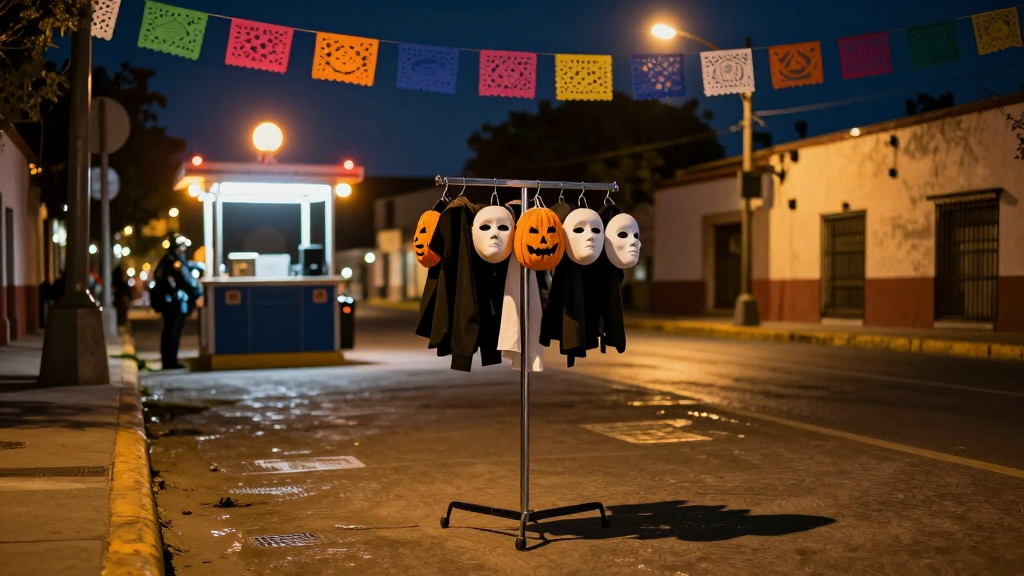
CULIACÁN, Mexico — For the third year running, the state of Sinaloa has entered its Halloween season with an official list of things you may not wear, and by every measurement that matters, the policy has been a quiet triumph.
I. The list. The Secretaría de Seguridad Pública asks residents to skip costumes depicting cartel figures, outfits with replica firearms, and — in a phrase that had to be invented for this purpose alone — “emplayados,” pranksters who coat themselves in tar and glitter and lie in roadways like dropped party decorations. Masks of El Chapo, once a retail category, have effectively been de-retailed. The guidance is detailed by the Mexican daily RÉCORD ahead of the October 31 and November 2 operations, which are checkpoints, not raids: officers waving people through, costume-consistent, thumbs-up.
II. The reasoning. During the 2024 fighting between the Chapitos and Mayos factions, armed men moved through the state at night, and a civilian in a black hoodie and a toy gun was, to a man with a real gun across the street, indistinguishable from a combatant. The ban is thus not censorship. It is fog reduction. The state has looked at the single most ambiguous night of the year — the one night when everyone is pretending to be dangerous — and removed the ambiguity. No other country on Earth has done this. Americans still solve the problem by not going outside.
III. The enforcement. It is social. In Culiacán, teenagers report that the ban is now simply taste: dressing as a narco reads the way wearing a suit to a beach party reads, outdated and slightly embarrassing to everyone present. A shop owner on the Avenida Camarón, who asked not to be named because she sells children’s witch costumes and does not enjoy the association, said her narco-mask inventory now exists only in the memories of men who used to buy it. “Three years ago I sold forty,” she said. “This year I sold a vampire. A small vampire. For four dollars.”
IV. The holiday that was already there. The other half of the calendar helps. Día de Muertos has its own costumes, its own skulls, its own relationship with death, and it is not a disguise — it is an invitation. The state’s calendar treats October 31 as an optional prelude and November 1–2 as the event proper, which means the banned costumes were always the imported kind, and the state did not so much prohibit a tradition as decline to fund one it never had.
By Friday morning the checkpoints had stopped no one. The tar — to the extent there was any — was, as always, entirely decorative.